
Can a Stage Hoist Really Survive Salt Fog Corrosion in Coastal Venues?
Salt fog destroys stage equipment faster than most people expect. One season near the coast, and untreated hoists start failing. The repair bills come next.
Stage hoists used in coastal venues face accelerated corrosion from salt-laden air. The right solution combines corrosion-resistant housing materials, sealed internal components, and a treated surface finish. Together, these three layers reduce failure risk and extend equipment service life significantly in high-humidity salt environments.

I've seen this problem up close. Customers from Southeast Asia, the Middle East, and coastal Europe come to us after losing equipment early. They expected years of service. They got months. When I look at what failed, the pattern is almost always the same. The corrosion starts small, then it spreads through every unprotected surface until the equipment becomes unreliable or unsafe.
The good news is that this is a solvable problem. We built a three-layer defense system specifically for this situation. I'll walk you through each layer and explain why it matters.
Why Does Salt Fog Destroy Stage Hoists So Quickly?
Most people underestimate how aggressive salt fog really is. You don't need to be on a ship. You just need to be close enough to the coast, and the damage starts.
Salt fog creates an electrochemical environment that accelerates metal oxidation. Chloride ions penetrate surface coatings, attack base metals, and degrade electrical contacts. In high-humidity coastal air, this process runs continuously, even when equipment is not in use.
Salt fog corrosion is not the same as ordinary rust from rain exposure. Rain wets a surface and then dries. Salt fog leaves a chloride residue that stays active on the metal surface. Humidity keeps that residue wet, and the corrosion cycle runs around the clock.
How Salt Fog Attacks Different Parts of a Stage Hoist
The failure points follow a predictable sequence. Understanding this sequence helps explain why a single protective measure is never enough.
| Component | Corrosion Risk | Failure Mode |
|---|---|---|
| Aluminum housing (untreated) | Medium | Surface pitting, structural weakening over time |
| Steel gearbox internals | High | Gear wear, lubricant contamination, seizure |
| Control board and wiring | Very High | Short circuits, relay failure, full electrical failure |
| Chain and hook assembly | High | Surface rust, reduced load rating, safety risk |
| Motor housing seams | Medium | Water and salt ingress, winding degradation |
The control board failure is the one that surprises customers most. They expect mechanical parts to wear out. They don't expect the electronics to die first. But in a salt fog environment, an unprotected control board can fail within one season. Chloride ions attack solder joints and copper traces. Humidity causes micro-condensation on the board surface. The result is intermittent faults that become permanent failures.
This is exactly why a single coating on the outside of the hoist is not enough. The threat comes from every direction, including from the inside.
What Makes a Housing Material Genuinely Corrosion-Resistant?
I get this question often from procurement managers who are comparing specifications. The housing material affects everything downstream. Get it wrong, and the rest of the protection system is compromised from the start.
Cast aluminum provides better corrosion resistance than extruded aluminum for stage hoists in coastal environments. The casting process creates a denser, more uniform grain structure with fewer micro-pores. This reduces the surface area available for chloride ion penetration and improves the durability of surface treatments applied on top.
We use cast aluminum for all our hoist housings. This is a deliberate design choice, not a cost decision. Cast aluminum costs more to produce than extruded aluminum. But it performs better under corrosion stress, and it holds surface treatments more reliably over time.
Cast Aluminum vs. Extruded Aluminum: A Practical Comparison
The difference is not always visible from the outside. Both materials look similar in product photos. The difference shows up after exposure.
| Property | Cast Aluminum | Extruded Aluminum |
|---|---|---|
| Material density | Higher, fewer internal voids | Lower, more micro-porosity |
| Surface treatment adhesion | Strong, uniform bond | Variable, weaker in porous areas |
| Structural rigidity | Better under load stress | More flexible, less impact-resistant |
| Corrosion resistance (untreated) | Good | Moderate |
| Long-term performance in salt fog | Proven in field data | Degrades faster at seams and joints |
| Cost to manufacture | Higher | Lower |
A few years ago, I was reviewing field return data from a coastal theater client in Southeast Asia. They had purchased hoists from two different suppliers. One used cast aluminum housing. The other used extruded aluminum with a similar external finish. After two years of operation, the extruded aluminum units showed deep pitting at the housing seams. The cast aluminum units from us showed only surface discoloration. No structural damage. No seal failure. That comparison stayed with me.
The housing material sets the baseline. It is not the complete solution, but without a solid baseline, the other protective layers have less to work with.
How Do You Protect the Internal Components From Salt Air Intrusion?
Protecting the outside of a hoist is straightforward. Protecting the inside is harder. Salt fog does not need a large opening to get in. It moves with air pressure changes, temperature cycling, and vibration. Any unsealed gap is an entry point.
Internal protection for coastal stage hoists requires sealed bearing assemblies, conformal coating on control boards, and corrosion-inhibiting lubricants in the gearbox. These measures work together to block salt air from reaching the components most vulnerable to electrochemical corrosion damage.
This is the layer that most budget hoists skip entirely. External coatings are visible. Internal protection is not. So manufacturers who compete only on price tend to cut here first. The customer does not notice during inspection. They notice six months later when the hoist stops responding correctly.
Three Internal Protection Measures and Why Each One Matters
Each internal measure addresses a specific failure pathway. They are not interchangeable.
| Protection Measure | Target Component | What It Prevents |
|---|---|---|
| Sealed bearing assemblies | Motor and gearbox bearings | Salt and moisture entry, premature bearing failure |
| Conformal coating on PCB | Control board | Chloride attack on solder joints and copper traces |
| Corrosion-inhibiting gearbox lubricant | Gears, shafts, internal surfaces | Lubricant breakdown, metal-to-metal corrosion |
| IP-rated cable entry seals | Wiring harness entry points | Salt air ingress through cable routes |
| Stainless steel fasteners (internal) | All internal fixing points | Galvanic corrosion between dissimilar metals |
The conformal coating on our control boards is a point I want to expand on. Conformal coating is a thin protective film applied to the board after assembly. It covers the entire surface including solder joints, component leads, and copper traces. It is transparent and does not affect board function. But it creates a physical barrier between the electronics and the environment. In salt fog conditions, this barrier is the difference between a board that lasts five years and one that fails in one.
We apply conformal coating as a standard step in our production process for all hoists intended for export. This is not an optional upgrade. It is part of the base specification. Customers in coastal regions should treat any hoist without conformal coating on the control board as unsuitable for their environment.
What Surface Finish Provides the Best Outer Defense Against Salt Corrosion?
The outermost layer of protection is the one you can see and touch. It is also the first layer that salt fog attacks directly. Choosing the right surface finish is not just about aesthetics. It is about how long that first barrier holds before the layers beneath it come under pressure.
For coastal stage hoists, a two-stage surface finish combining sandblasting and electrostatic powder coating provides the strongest outer corrosion barrier. Sandblasting removes surface contaminants and creates a mechanical profile that improves coating adhesion. Powder coating then seals the surface with a uniform, impact-resistant finish.
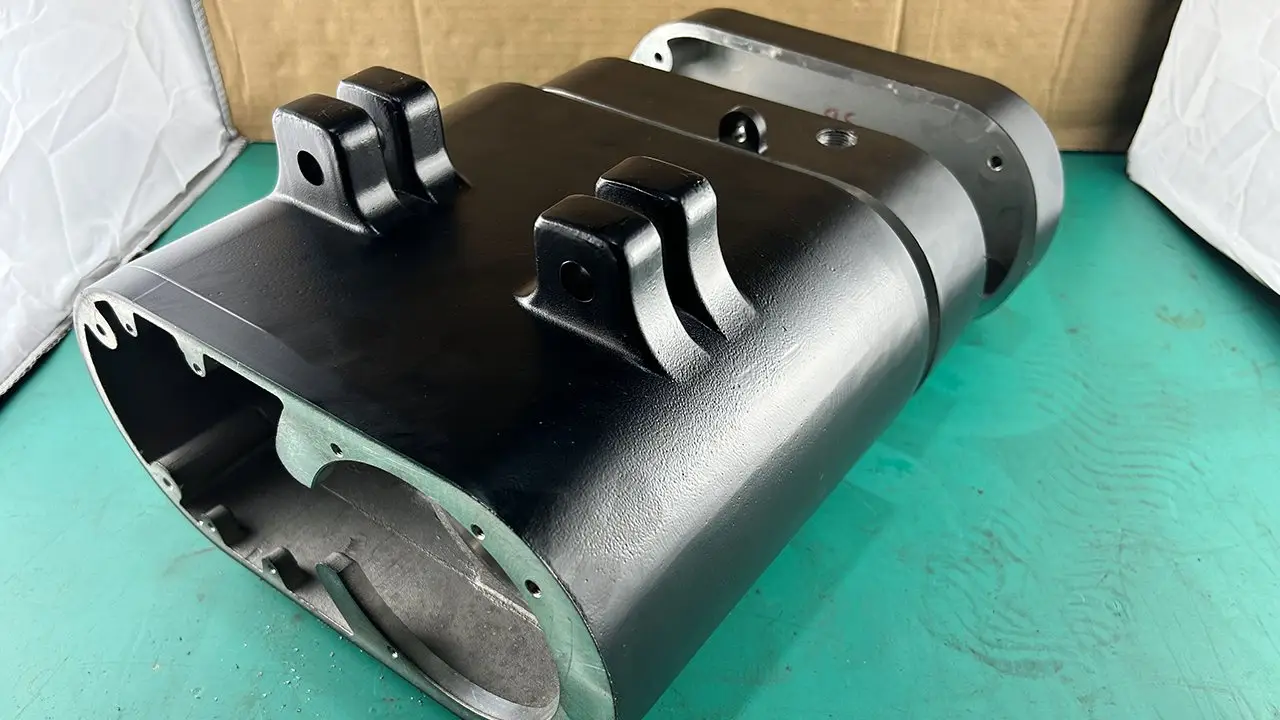
I want to be honest about what surface finish can and cannot do. A good outer finish slows corrosion significantly. It does not stop it permanently if the underlying material or internal protection is weak. The finish is the first line of defense. If it fails early, the attack on the housing material and internal components accelerates.
Comparing Common Surface Finish Options for Stage Hoists in Salt Environments
Not all finishes perform equally. The table below reflects what I have seen in field performance data and in direct comparisons with returned units.
| Surface Finish Type | Salt Fog Resistance | Impact Resistance | Typical Service Life (Coastal) | Notes |
|---|---|---|---|---|
| Bare aluminum (no treatment) | Very Low | N/A | Months | Not acceptable for coastal use |
| Anodizing only | Moderate | Moderate | 1–2 years | Better than bare, still limited |
| Spray paint | Low | Low | Less than 1 year | Chips and peels quickly |
| Powder coating (standard) | Good | High | 3–5 years | Good baseline for most coastal venues |
| Sandblast + powder coating | Very Good | High | 5+ years | Recommended for regular coastal exposure |
| Sandblast + powder coat + UV top coat | Excellent | High | 7+ years | For permanent outdoor or near-shore installations |
We use the sandblast-plus-powder-coating combination as our standard process. The sandblasting step is the one that makes the biggest difference in long-term performance. Without it, powder coating sits on a smooth surface and tends to delaminate at edges and corners when impacted or exposed to thermal cycling. With it, the coating bonds mechanically into the surface profile and holds significantly longer.
Customers sometimes ask whether they can apply additional protection in the field after purchase. Yes, they can. Wax-based corrosion inhibitor sprays on external surfaces add a useful supplementary layer. But field-applied products cannot replicate what is done during manufacturing. The best time to specify corrosion protection is before the equipment is built.
Conclusion
Salt fog corrosion is manageable with the right equipment design. Cast aluminum housing, sealed internals with conformal-coated boards, and a sandblast-plus-powder-coat finish form a reliable three-layer defense for coastal stage hoists.
