
Is Single-Phase Circuit Design Really Safe for Your Stage Hoist?
You think single-phase power is simpler. You plug it in, it runs. But in professional stage lifting, that assumption can cost you more than you expect.
Single-phase stage hoists can operate under the right conditions, but unstable voltage or current on-site puts the circuit under real stress. The most common failure point is the resistor component, which burns out faster when power supply fluctuates. For most professional stage lifting applications, three-phase power is the more reliable choice.
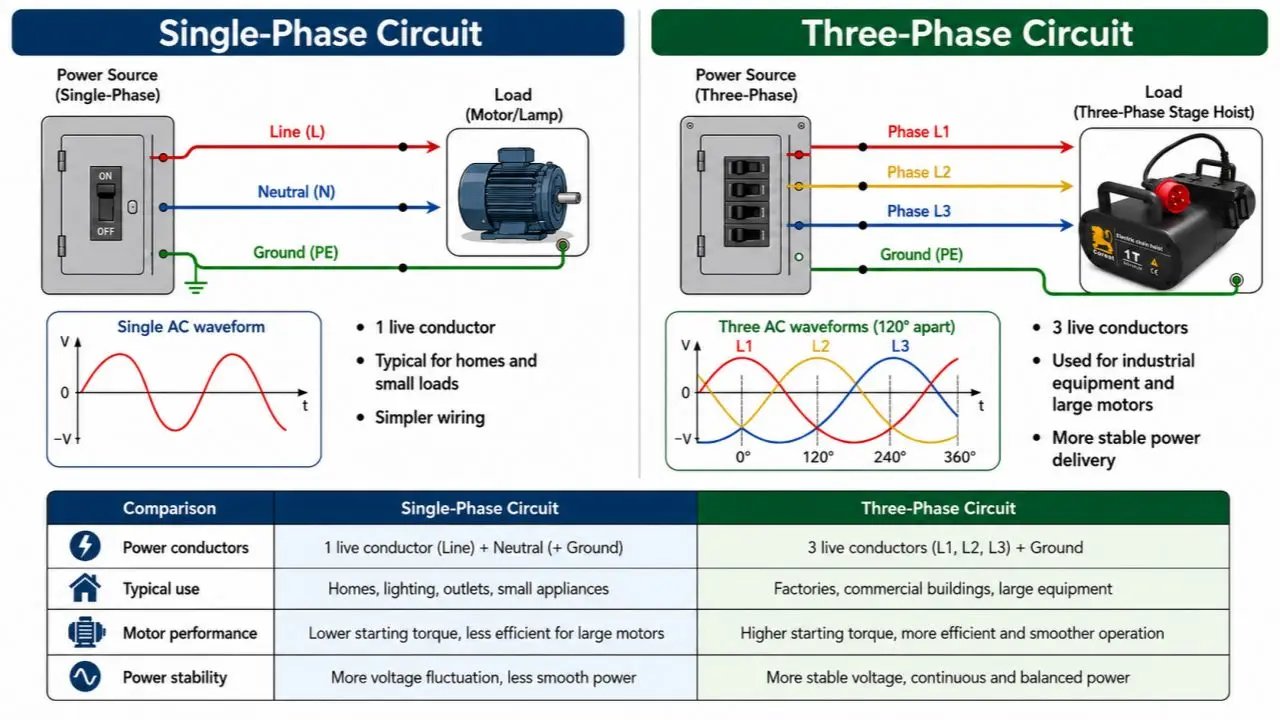
We have been through this before — not as theory, but as a product we designed, sold, and supported in the field. At Coreat Stage, we produced single-phase stage electric chain hoists in our earlier years. After repeated after-sales cases and technical review, we stopped. This article explains what we learned and why it matters for your next procurement decision.
Is Single-Phase Power Really "Easier" for Stage Hoists?
Many buyers assume single-phase is the simpler path. It is available almost everywhere, and it seems easier to connect on-site. But does easier access mean safer operation?
For stage electric chain hoists, the real question is not whether the hoist can be connected to single-phase power. The real question is whether the site's electrical environment can support stable hoist operation under actual lifting loads. These are two very different questions.
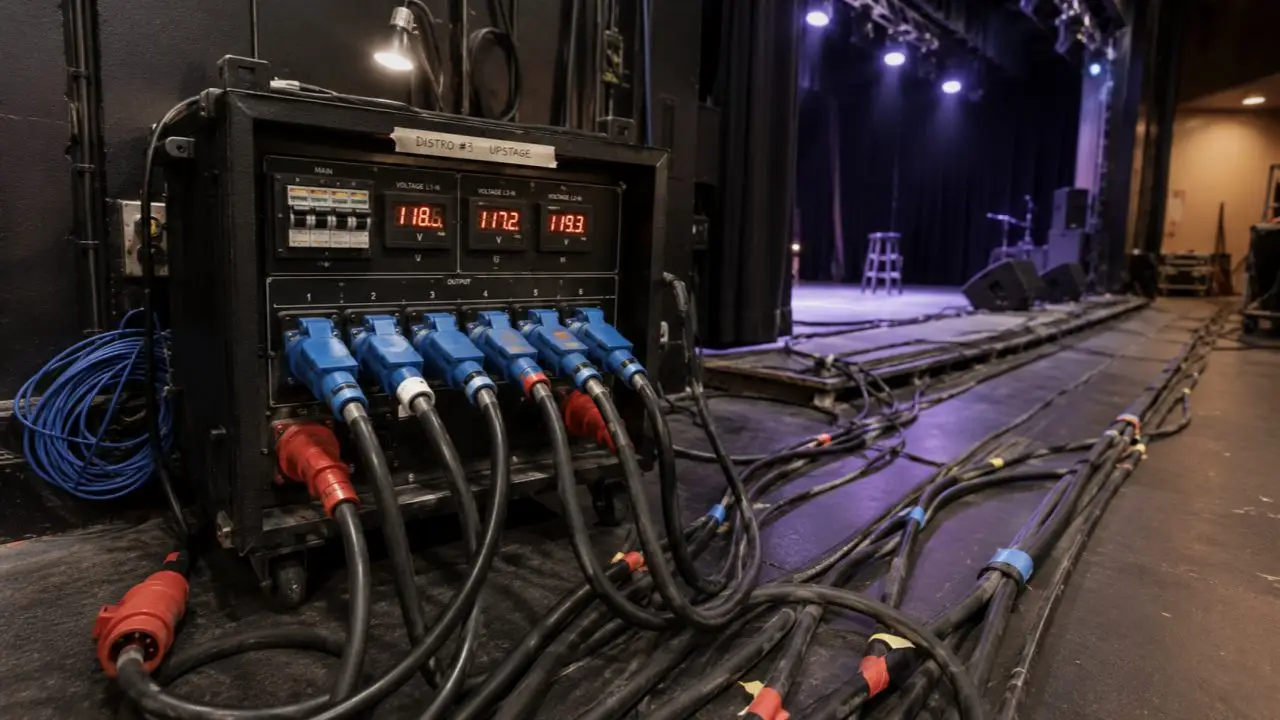
"Easier to connect" is not the same as "safer to run." Many venues, temporary sites, and rental applications where single-phase power is available are also the same environments where voltage and current supply is least stable1. A small theater, an outdoor event tent, a temporary exhibition hall — these are exactly the places where power quality is hardest to control.
A stage hoist is not a portable speaker or a lighting fixture. It carries real mechanical load above people2, truss systems, and expensive production equipment. When the load increases, the electrical demand on the circuit increases at the same moment3. If the power supply cannot hold a stable voltage and current under that demand, the circuit components inside the hoist absorb the difference. That is where the risk starts.
From a procurement standpoint, choosing single-phase because it is available is a different decision from choosing single-phase because it is suitable. Before you make that choice, it is worth understanding what actually happens inside the circuit when site power is not ideal.
What Makes Single-Phase Circuits More Vulnerable Under Stage Conditions?
| Factor | Single-Phase Stage Hoist | Three-Phase Stage Hoist |
|---|---|---|
| Power distribution | All power drawn through one phase4 | Load distributed across three phases |
| Current demand per phase | Higher | Lower per phase |
| Sensitivity to voltage fluctuation | Higher | Lower |
| Resistor dependency | Required in circuit design | Typically not required |
| Risk under unstable site power | Higher | Lower |
| Common after-sales issue | Resistor burnout | Less common |
The table above is based on our own engineering and field experience. It is not a universal industry rule. But it reflects a pattern we saw repeatedly in our after-sales cases from earlier single-phase hoist models.
Why Does the Resistor Burn Out? And Why Do Customers Misunderstand It?
This is the specific failure we saw most often. When a customer reported a fault with our earlier single-phase stage hoists, the damaged component was frequently a resistor. From the customer's side, the product looked like it broke too quickly. From our side, the engineering picture was more complicated.
In single-phase stage hoist circuit design, resistor components are required to manage the electrical behavior of the motor during operation5. When the site voltage or current fluctuates — even within a range the customer considers "normal" — the resistor absorbs more stress. Over repeated cycles, it burns out6.
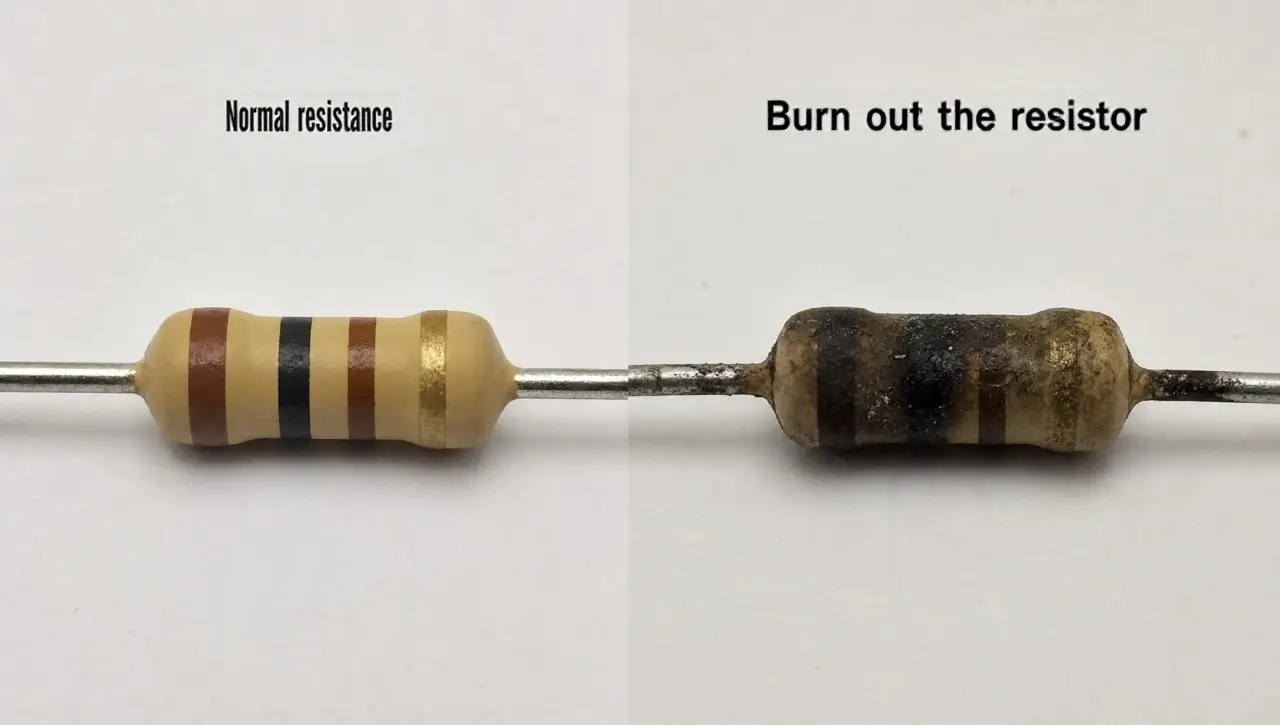
The customer sees a burnt component and thinks: bad quality. That is a fair first reaction. But the actual cause is different. The resistor did not fail because it was manufactured poorly. It failed because the electrical stress it was asked to absorb was beyond what the circuit was designed to handle continuously7.
Why This Gap in Understanding Creates Real Problems
The electrical working principle behind resistor failure in a single-phase stage hoist circuit is not obvious to someone who is not an engineer. Most procurement managers, rental company operators, and even site technicians do not have a detailed understanding of how power fluctuation interacts with internal circuit components. They see a part fail. They file a warranty claim. They lose confidence in the product.
We have had these conversations. A customer would contact us after a resistor failure, frustrated, believing they had received a defective hoist. We would ask about the site power conditions — voltage stability, cable length, number of hoists running on the same circuit — and the answers would almost always reveal an unstable electrical environment.
This is not the customer's fault. They did not know what to check. The mismatch between the single-phase circuit design and the site power conditions was invisible to them until a component failed.
| Customer Perception | Engineering Reality |
|---|---|
| "The resistor burned out, so the hoist is low quality" | Resistor failure is often caused by voltage/current instability, not manufacturing defect |
| "We used it normally, it should not fail" | Normal use in an unstable power environment still stresses the circuit |
| "Replace the resistor and it should be fine" | If site power conditions have not changed, the replacement resistor faces the same stress |
| "This is a warranty issue" | The root cause may be the power supply, not the product |
These conversations take time, damage trust, and create after-sales costs that affect both sides. The real cost of single-phase stage hoist procurement is not only the price of the hoist. It includes the time, the replacement parts, and the damaged relationship when a failure is misunderstood.
What Did We Actually Do with Our Single-Phase Stage Hoist Products?
This is the part of the article that most manufacturers would not tell you directly. We will.
In our earlier years at Coreat Stage, we designed, produced, and sold single-phase stage electric chain hoists. We had customers who used them. We had customers who asked for them specifically because single-phase power was what they had available on-site.
After repeated after-sales cases involving unstable voltage, current fluctuation, and resistor component failures, our engineering and product team reviewed the data from real field applications. The conclusion was clear enough to act on. We stopped offering single-phase stage hoist models.

This was not a decision we made based on theory or because we had read a study about three-phase power being better. It was a decision we made because we had seen the pattern repeat across different customers, different regions, and different site conditions. The common factor was always the same: single-phase circuit design under unstable power supply conditions creates a vulnerable product, even when the manufacturing quality itself is solid.
What This Decision Reflects About Stage Hoist Procurement
The choice to stop offering single-phase stage hoists was also a responsibility decision. A stage hoist operates above people. Above lighting rigs. Above expensive audio equipment. Above the heads of an audience. The threshold for acceptable risk in that environment is very different from the threshold for a workshop tool or a warehouse crane.
| Consideration | Why It Matters for Single-Phase Stage Hoists |
|---|---|
| Operating environment | Above people and equipment, zero tolerance for unexpected failure |
| Power supply variables | Site power quality is outside our control after shipment |
| Customer technical knowledge | Many users will not recognize unstable power as a risk factor |
| After-sales impact | Resistor failure is difficult to diagnose remotely and easy to misattribute |
| Long-term buyer relationship | Repeated unclear failures damage trust regardless of actual cause |
We could have continued selling single-phase stage hoists and managing the after-sales cases one by one. But that would have meant continuing to put buyers in a situation where the product's reliability depended on a power condition they might not be able to guarantee. That did not feel like the right product direction for a company focused on professional entertainment lifting.
Should You Ever Choose a Single-Phase Stage Hoist?
We are not saying every single-phase stage hoist will fail. We are saying that the risk is significantly higher when the site power conditions are not fully stable, and that many buyers cannot confidently confirm their power conditions are stable enough before they purchase.
If you are considering a single-phase stage hoist, the right question is not "Can this hoist run on single-phase power?" The right question is: "Can my site guarantee the voltage and current stability that a single-phase stage hoist circuit requires to operate safely over repeated use cycles?"
Most procurement managers and technical directors cannot answer that second question with full confidence. And in professional stage environments, uncertainty is risk.
A Practical Checklist Before Choosing Single-Phase
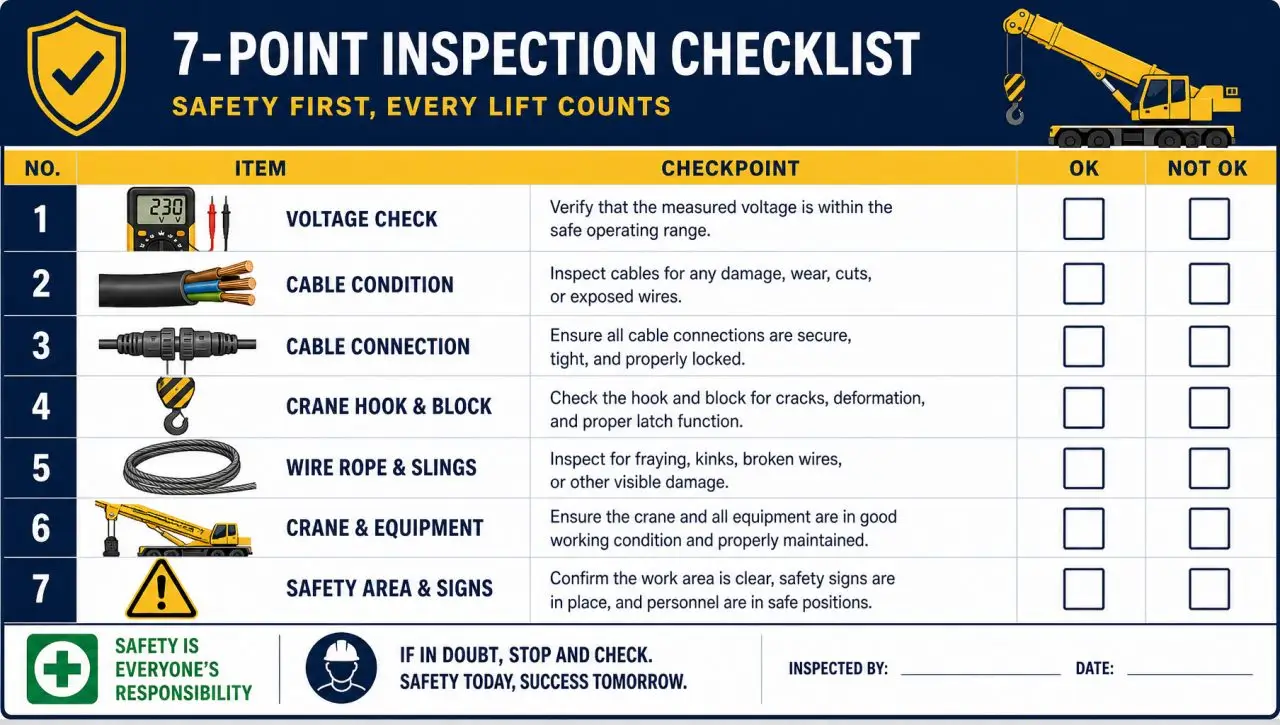
Before any buyer commits to a single-phase stage hoist, we suggest reviewing each of the following:
| Checklist Item | What to Confirm |
|---|---|
| Voltage stability | Is the local supply voltage consistent under full load? |
| Current capacity | Is the circuit protected and sized for hoist load demand? |
| Cable length | Are cable runs short enough to avoid significant voltage drop8? |
| Number of hoists | How many hoists will run simultaneously on the same supply? |
| Frequency of use | Is the hoist used for brief events or continuous long-duration operation? |
| User technical capability | Can the site team identify and respond to power-related faults? |
| After-sales infrastructure | Is there quick access to spare parts if resistor replacement is needed? |
If the answers to any of these are uncertain, three-phase stage hoists are the safer and more professional choice. Three-phase power distributes the electrical load across all phases, reduces the current demand per phase9, and removes the need for the resistor components that are most vulnerable in single-phase circuit design.
For professional stage lifting applications — permanent venue installations, touring productions, rental companies operating across multiple sites — three-phase is the standard we recommend today10. Not because single-phase is always wrong, but because three-phase removes a category of risk that we have already seen cause real problems in the field.
Conclusion
Single-phase stage hoists carry hidden risks when site power is unstable. Resistor failure, buyer misunderstanding, and after-sales disputes are the pattern we saw repeatedly. That experience is exactly why Coreat Stage no longer offers single-phase stage hoist models, and why we recommend three-phase configurations for most professional stage lifting applications.
Have questions about stage hoist power configurations for your project? Contact Coreat Stage directly. 📞 +86 1824701468 | 📧 info@globalcoreat.com | 🌐 globalcoreat.com Address: 2 Qingfeng Road, Shawan Street, Panyu District, Guangzhou, China
"[PDF] Power Quality Site Surveys: Fact, Fiction, and Fallacies", https://www.nist.gov/document/pqsurveysfffpdf. Research on power quality in temporary and light-commercial electrical installations indicates that voltage stability is more difficult to maintain where supply infrastructure is not purpose-designed for the connected load profile, a condition common in temporary event and small-venue settings. Evidence role: general_support; source type: research. Supports: Temporary and non-purpose-built electrical installations are more susceptible to power quality issues including voltage fluctuation and harmonic distortion compared to permanent, engineered power infrastructure. Scope note: The article does not cite specific power quality measurements from stage environments; this claim is supported by general power quality literature rather than entertainment-industry-specific studies. ↩
"1926.753 - Hoisting and rigging. | Occupational Safety and Health ...", http://www.osha.gov/laws-regs/regulations/standardnumber/1926/1926.753. Standards such as ANSI E1.6-1 (Entertainment Technology – Powered Hoist Systems) and guidance from bodies including ESTA establish that hoists operating above occupied performance spaces are subject to elevated safety requirements, reflecting the life-safety consequences of mechanical failure in such environments. Evidence role: expert_consensus; source type: institution. Supports: Industry and regulatory standards for entertainment rigging recognize that overhead mechanical loads above occupied areas require stricter design, inspection, and operational controls than general-purpose lifting equipment. Scope note: Specific regulatory requirements vary by jurisdiction and venue type; the article does not specify which standards framework applies to the installations discussed. ↩
"[PDF] Determining Electric Motor Load and Efficiency - Department of Energy", https://www.energy.gov/sites/prod/files/2014/04/f15/10097517.pdf. For induction motors, current draw is directly related to mechanical load: as torque demand increases, stator current rises to supply the additional power, a fundamental relationship described in standard electromechanical references. Evidence role: mechanism; source type: education. Supports: As mechanical load on an electric motor increases, the motor draws proportionally higher current from the supply to maintain speed and deliver the required torque. Scope note: This is a well-established general principle of motor operation; the specific rate of current increase under stage hoist loading conditions depends on motor design parameters not addressed by general references. ↩
"Three-phase electric power - Wikipedia", https://en.wikipedia.org/wiki/Three-phase_electric_power. In a balanced three-phase system, power is distributed equally across three conductors, reducing the current each phase must carry relative to a single-phase system delivering equivalent total power; this principle is documented in standard electrical engineering references covering polyphase systems. Evidence role: mechanism; source type: encyclopedia. Supports: In single-phase systems all power is delivered through one conductor pair, whereas three-phase systems distribute load across three phases, reducing current per phase for equivalent total power. Scope note: General electrical engineering references describe this principle for power systems broadly; direct empirical data specific to stage hoist motor circuits would provide stronger support for the magnitude of the difference claimed. ↩
"Start and Run Capacitors for Electric Motors", https://www.aces.edu/blog/topics/farming/start-and-run-capacitors-for-electric-motors/. Single-phase induction motors lack a rotating magnetic field at standstill and require auxiliary starting mechanisms—commonly resistive or capacitive components—to initiate rotation, a design requirement absent in three-phase induction motors, which are inherently self-starting due to their naturally rotating magnetic field. Evidence role: mechanism; source type: education. Supports: Single-phase induction motors are not inherently self-starting and require auxiliary starting components such as resistors or capacitors, while three-phase induction motors produce a rotating magnetic field and are self-starting without such components. Scope note: Standard motor theory references describe this distinction for general induction motors; the specific resistor topology used in stage hoist circuits may differ from textbook starting configurations and would require manufacturer-level documentation for precise confirmation. ↩
"Investigation of the Degradation Mechanism of SiC MOSFET ...", https://pmc.ncbi.nlm.nih.gov/articles/PMC10384136/. Electronics reliability literature documents that resistors exposed to repeated thermal stress from overcurrent conditions undergo progressive degradation—including resistance drift and eventual open-circuit failure—as a function of cumulative thermal cycling, a mechanism relevant to components operating in variable-load electrical environments. Evidence role: mechanism; source type: research. Supports: Resistors subjected to repeated thermal cycling from overcurrent or voltage stress experience cumulative degradation of their resistive element, increasing failure probability over time. Scope note: General component reliability references describe this mechanism for electronic resistors broadly; the specific failure rate under stage hoist operating conditions would require empirical data from the hoist circuit context. ↩
"[PDF] Chapter 3. Failures and Failure Classification - NTNU", https://www.ntnu.edu/documents/624876/1277046207/SIS+book+-+chapter+03+-+failures+and+failure+classification/36f29566-bd55-4a91-b002-1e17a177c035. Reliability engineering literature, including frameworks such as MIL-HDBK-338B, distinguishes between manufacturing-defect failures and overstress failures, where the latter occur when applied electrical, thermal, or mechanical stress exceeds component design ratings regardless of manufacturing quality. Evidence role: definition; source type: research. Supports: Reliability engineering distinguishes between failures caused by manufacturing defects and failures caused by application stress exceeding component design limits, with the latter classified as overstress or misapplication failures rather than quality defects. Scope note: General reliability engineering references support the conceptual distinction; attribution of a specific field failure to overstress versus defect requires formal failure analysis of the actual components, which the article does not document. ↩
"Maximum Allowable Voltage Drop", https://www.txdot.gov/manuals/trf/hwi/electrical_systems/calculating_voltage_drop-chdhdebc/maximum_allowable_voltage_drop-i1006115.html. IEC and national electrical installation standards specify maximum permissible voltage drop in supply cables—commonly 3–5% for final circuits—to ensure connected equipment receives voltage within its operational tolerance; excessive drop can cause motors to draw higher current and overheat. Evidence role: definition; source type: institution. Supports: Voltage drop across cable runs is a recognized electrical installation concern, with international standards specifying acceptable limits to ensure equipment operates within design parameters. Scope note: Specific voltage drop thresholds vary by standard, jurisdiction, and equipment type; the article does not specify which standard applies to the stage hoist installations discussed. ↩
"Power factor - Wikipedia", https://en.wikipedia.org/wiki/Power_factor. In a three-phase system, for a given total power output, the current per phase is approximately 1/√3 times that of an equivalent single-phase system at the same line voltage, a relationship derived from polyphase power theory and documented in standard electrical engineering references. Evidence role: mechanism; source type: encyclopedia. Supports: Three-phase systems deliver the same total power as a single-phase system at a lower current per conductor, reducing resistive losses and thermal stress on circuit components. Scope note: The precise current reduction depends on power factor and load balance; the article's claim is directionally supported but the magnitude varies with operating conditions. ↩
"Single-Phase vs Three-Phase Electric Chain Hoists: Which Is Best?", https://liftingequipmentstore.us/blogs/guides/should-i-choose-a-single-or-three-phase-hoist?srsltid=AfmBOor3BApfA1CbrzJ5Cb4NVaFJemdWRJ707Hsdie9U1OpOhFBy0aA0. Technical specifications published by entertainment industry bodies and hoist manufacturers for professional-grade stage electric chain hoists commonly designate three-phase power supply as the standard configuration, reflecting the load distribution and reliability advantages of polyphase systems in continuous-duty lifting applications. Evidence role: expert_consensus; source type: institution. Supports: Professional entertainment hoist specifications and industry guidance documents commonly specify three-phase power supply as the standard electrical configuration for stage lifting equipment. Scope note: The article does not cite a specific industry standard document; this note reflects general industry practice as observable in published product specifications and trade body guidance rather than a single authoritative source. ↩
