
Are you trying to choose between a Chinese stage hoist and an imported one? The price gap is big, but you worry about safety. Let's look past the price tag.
Your best choice depends on your project timeline, budget, and need for support. Certified Chinese hoists offer fast delivery and competitive prices.1 Their quality now often matches imported brands2, making them a strong strategic option for many businesses.
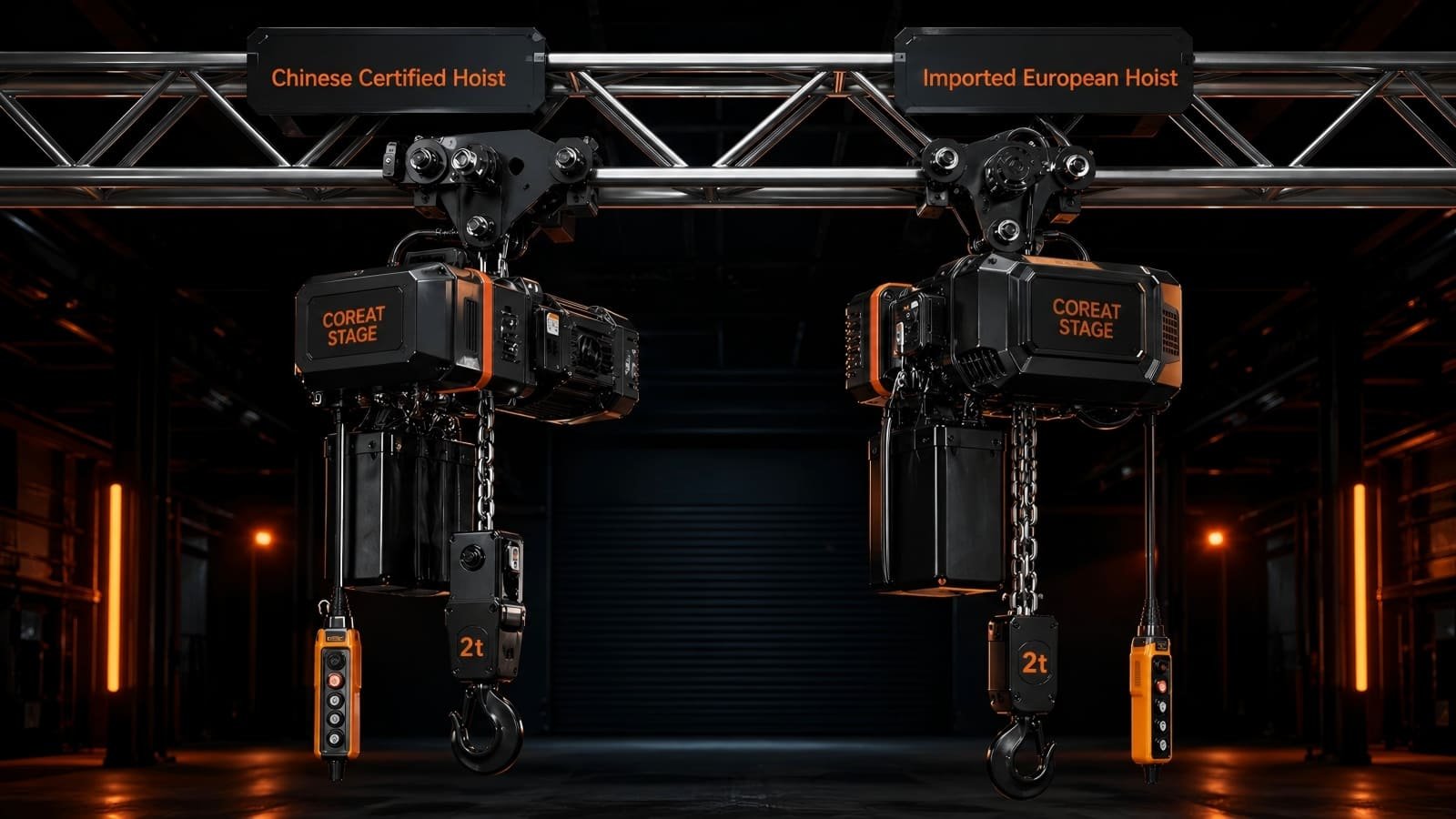
The decision is not as simple as "Made in China" versus "Made in Europe." For years, I've helped clients navigate this choice, and it always comes down to more than just the initial cost. To make the right decision for your company, you need to understand the hidden factors that impact your safety, efficiency, and bottom line. Let's dig into the details that truly matter for your business.
How Do Price and Delivery Time Really Compare?
Your project has a tight deadline and a strict budget. Waiting months for an expensive European hoist3 could hurt your profits. This is where we need to look at alternatives.
Chinese stage hoists are much more affordable and have shorter lead times. They often deliver in weeks, not months.4 This speed and value make them a great option for rental companies and time-sensitive projects, especially when buying from a reputable supplier.
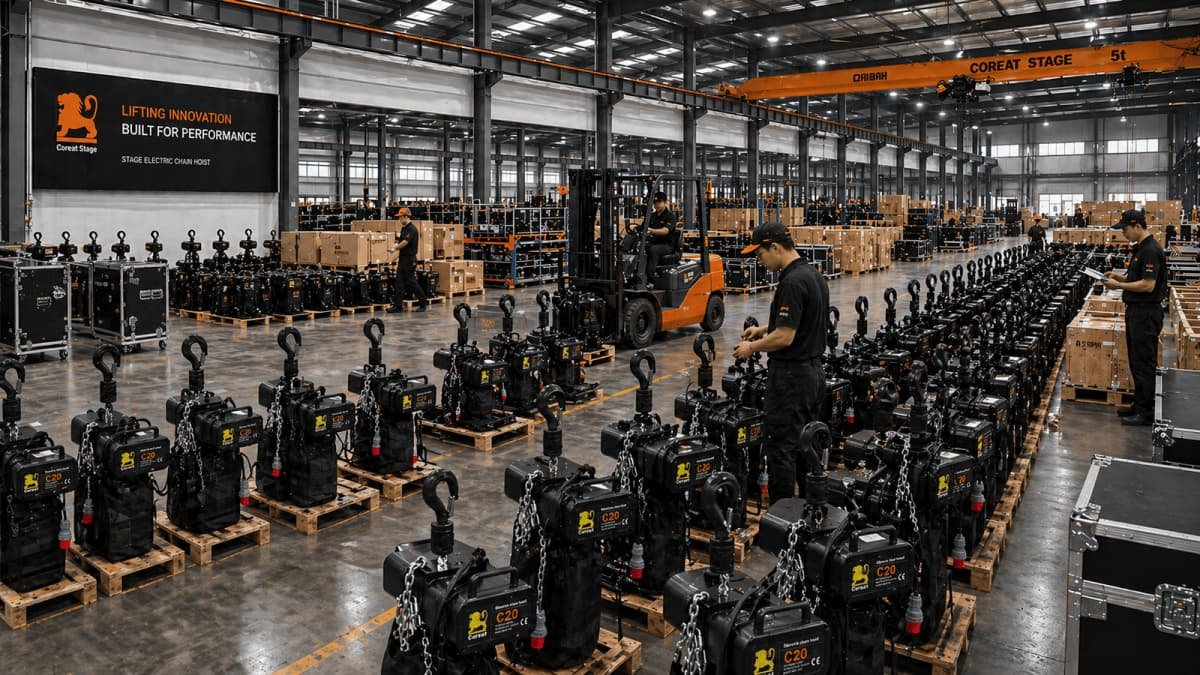
When I talk to procurement managers, their two biggest concerns are almost always cost and availability. European brands have a legacy of quality, but this comes with a premium price and long waiting periods. It's not uncommon to wait six months to a year for a large order.5 For a rental company that needs to expand its inventory for the upcoming season, that timeline just doesn't work.
Chinese manufacturers operate differently. Because of a robust local supply chain6 and more flexible production schedules, a factory like ours can often produce and ship an order of 200 hoists in under a month. This speed allows a business to react to market demand quickly and see a return on investment much sooner. The lower price isn't just about cheaper labor; it's about a more efficient manufacturing ecosystem7.
Price and Lead Time Comparison
| Factor | Certified Chinese Manufacturer | European Brand |
|---|---|---|
| Unit Price | Lower initial investment | Premium pricing |
| Lead Time (100 units) | 3-4 Weeks | 6-12 Months |
| Business Impact | Fast inventory turnover, quick ROI | Requires long-term planning, higher capital outlay |
Has Chinese Hoist Quality Finally Caught Up to European Standards?
You may have heard stories about low-quality Chinese equipment failing. You cannot risk your reputation or the safety of your crew on an unreliable hoist. But the market has changed significantly.
Top-tier Chinese manufacturers have shifted from simply copying designs to genuine innovation8. Many now hold German TÜV certifications9, which means their quality and safety align with European standards10. The key is to verify these credentials and avoid the cheap, uncertified copycats.
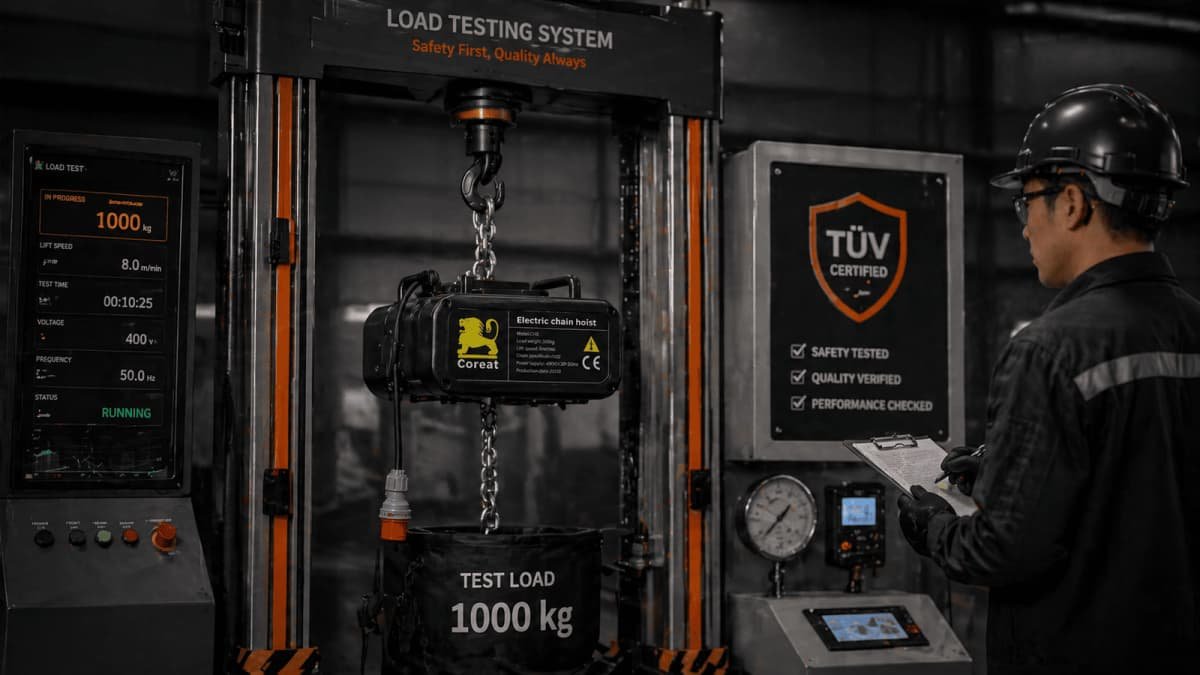
Let's be honest. A decade ago, many Chinese hoists were direct copies of European models, often with inferior materials. But the industry has matured. The best manufacturers have invested heavily in their own research and development. We've spent years refining our designs, from the internal gear mechanisms to the integrated control boards11. For example, we use cast aluminum housing because it offers superior strength and durability compared to the cheaper extruded aluminum12 found in low-end models.
The biggest proof of this evolution is third-party certification. A TÜV certificate isn't just a piece of paper. It means an independent German body has rigorously tested the hoist for safety, durability, and performance, confirming it meets strict European norms. When you're comparing options, always ask for the TÜV certificate. This is the clearest way to separate a professional, reliable manufacturer from a low-quality factory. A good supplier will be proud to show you their quality control process, from raw material inspection to 100% final testing before shipment.
What Happens When You Need a Spare Part or Technical Support?
A hoist is down in the middle of a tour. Getting a replacement part from a European supplier could take weeks, costing you jobs and money. This is where responsive support becomes critical.
Chinese manufacturers often provide faster and more affordable after-sales support. Spare parts are usually in stock, cost-effective, and can be shipped quickly. In contrast, sourcing parts for some imported brands can be a slow and expensive process, which impacts your total cost of ownership.
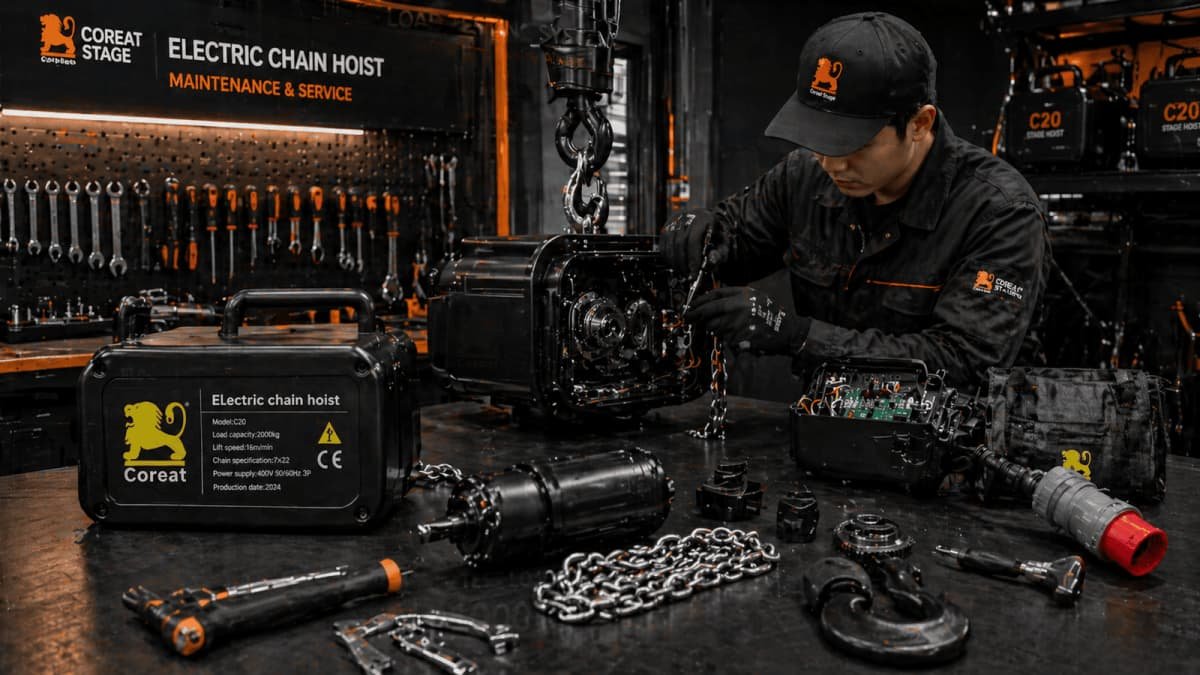
The total cost of a hoist isn't just the purchase price. It includes maintenance, repairs, and the cost of downtime. This is an area where I’ve seen many clients benefit from working with a Chinese manufacturer. When you need a spare part, you can contact the factory directly. The response is usually fast, and the parts are affordable. We can typically ship a replacement component anywhere in the world in a matter of days.
This can be a different story with some imported brands. You might have to go through a regional distributor, who may or may not have the part in stock. The process can be slow, and the cost of original spare parts can be surprisingly high. For a rental company with dozens or hundreds of hoists in the field, easy and affordable access to spare parts is essential for keeping the business running smoothly. Fast, cost-effective support lowers your long-term operating costs and protects your investment.
After-Sales Support Comparison
| Support Factor | Certified Chinese Manufacturer | European Brand |
|---|---|---|
| Response Time | Often within 24 hours directly | Can be slower, through distributors |
| Spare Part Cost | Lower | Higher |
| Part Availability | High, direct from the factory | Can have long lead times |
| Total Cost of Ownership | Lower due to affordable maintenance | Higher due to expensive parts |
Conclusion
The choice is no longer just about price. It is a balance of delivery time, certified quality, and long-term support. A certified Chinese hoist can be a smart, strategic investment.
"Made in China 2025: Evaluating China's Performance", https://www.uscc.gov/research/made-china-2025-evaluating-chinas-performance. Trade and manufacturing data on China’s machinery sector can support the contextual claim that Chinese industrial equipment often benefits from large-scale production capacity and export-oriented supply chains, which may contribute to price and delivery advantages. Evidence role: general_support; source type: institution. Supports: Certified Chinese hoists offer fast delivery and competitive prices.. Scope note: Such sources would support industry context rather than verify the pricing or delivery time of any specific stage-hoist supplier. ↩
"1926.552 - Material hoists, personnel hoists, and elevators. - OSHA", http://www.osha.gov/laws-regs/regulations/standardnumber/1926/1926.552. Certification and product-safety standards documentation can support the claim that products meeting the same recognized safety standards may be evaluated against comparable technical requirements, though this does not prove equal quality across all brands. Evidence role: expert_consensus; source type: institution. Supports: Certified Chinese stage hoists can meet technical and safety requirements comparable to imported brands when certified to the same standards.. Scope note: Standards compliance indicates minimum conformity, not identical durability, engineering quality, or long-term field performance. ↩
"Europe Supply Chain Management Market Size & Growth, 2034", https://www.marketdataforecast.com/market-reports/europe-supply-chain-management-market. European manufacturing and supply-chain reports can document extended delivery times and capacity constraints in machinery sectors, providing context for long procurement lead times. Evidence role: general_support; source type: institution. Supports: Some European hoist procurement timelines can extend to several months.. Scope note: This would contextualize potential delays but would not establish that all European stage-hoist orders require months of waiting. ↩
"Made in China 2025: Evaluating China's Performance", https://www.uscc.gov/research/made-china-2025-evaluating-chinas-performance. Evidence from logistics or manufacturing lead-time studies can support the general point that shorter production and export cycles are possible in high-capacity manufacturing supply chains. Evidence role: general_support; source type: research. Supports: Chinese stage hoists are often available on shorter lead times than some imported alternatives.. Scope note: A neutral source would not prove that any particular Chinese stage-hoist manufacturer usually delivers within weeks. ↩
"Machinery orders cool but lead time still almost six months - CEMA", https://www.farmersjournal.ie/machinery/news/machinery-orders-cool-but-lead-time-still-almost-six-months-cema-716990. Supply-chain surveys or industry reports on machinery backlogs can support the contextual claim that large industrial-equipment orders may face multi-month lead times. Evidence role: statistic; source type: institution. Supports: Large equipment orders can sometimes have six- to twelve-month lead times.. Scope note: The source should be treated as evidence of possible machinery-sector backlogs, not as a verified lead time for every European stage-hoist brand. ↩
"How do special economic zones and industrial clusters drive ...", https://documents.worldbank.org/en/publication/documents-reports/documentdetail/310891468018256346/how-do-special-economic-zones-and-industrial-clusters-drive-chinas-rapid-development. International trade and manufacturing analyses describe China’s dense supplier networks and industrial clusters, which can support the claim that local supply-chain depth contributes to manufacturing responsiveness. Evidence role: mechanism; source type: institution. Supports: Chinese manufacturers may benefit from robust local supply chains that shorten production timelines.. Scope note: This supports the general mechanism of supply-chain depth and does not verify an individual factory’s production capacity. ↩
"[PDF] China's Special Economic Zones and Industrial Clusters", https://www.lincolninst.edu/app/uploads/legacy-files/pubfiles/2261_1600_Zeng_WP13DZ1.pdf. Research on industrial clustering and supply-chain integration can support the proposition that geographic concentration of suppliers and manufacturers can reduce coordination costs and improve production efficiency. Evidence role: mechanism; source type: paper. Supports: Lower prices can reflect efficiencies in manufacturing ecosystems rather than labor costs alone.. Scope note: This explains a plausible economic mechanism but does not measure the exact cost difference for stage hoists. ↩
"Who patents, how much is real invention and how relevant ... - OECD", https://www.oecd.org/en/publications/who-patents-how-much-is-real-invention-and-how-relevant-a-snapshot-of-firms-and-their-inventions-based-on-the-2016-sipo-china-patent-survey_9a4dd70c-en.html. Patent, R&D, or industrial-policy data can support the broader observation that Chinese manufacturing has increasingly moved from imitation toward innovation in machinery and advanced manufacturing sectors. Evidence role: historical_context; source type: research. Supports: Some Chinese manufacturers have moved from imitation toward innovation.. Scope note: Sector-wide innovation trends do not prove that every Chinese stage-hoist producer has independently innovative designs. ↩
"Product certification and certification marks | TÜV Rheinland | US", https://www.tuv.com/usa/en/product-certification.html. TÜV and European conformity-assessment documentation can establish that TÜV bodies conduct independent testing, inspection, and certification for products against defined safety and technical standards. Evidence role: definition; source type: institution. Supports: German TÜV certifications indicate independent third-party testing or certification against defined standards.. Scope note: The existence of TÜV certification supports third-party assessment only if the certificate is authentic and applicable to the specific hoist model. ↩
"EN 14492-2:2019 - Power Driven Hoists Safety and Testing Standard", https://standards.iteh.ai/catalog/standards/cen/0a41cfe7-49aa-412d-8591-e25494f80ec2/en-14492-2-2019?srsltid=AfmBOopfWdfraRiBGoNqemQobEJBnZXqSaZFNKngfAjqNiUQDvYWHOye. European machinery and hoist standards, such as EN 14492-2 for power-driven winches and hoists, define safety-related requirements that can be used to assess whether a hoist conforms to European norms. Evidence role: definition; source type: institution. Supports: Certified hoists can align with European safety standards when tested against relevant EN machinery standards.. Scope note: Compliance with a relevant EN standard supports alignment with specified safety requirements, not a blanket equivalence with all European-made products. ↩
"[PDF] University of Illinois at Urbana-Champaign Crane and Hoist Safety ...", https://docs.fs.illinois.edu/wp-content/uploads/2023/02/crane_safety_program.pdf. Engineering references on electric chain hoists can support the technical context that modern hoists use control systems, limit switches, brakes, and electrical components as part of safe lifting operation. Evidence role: mechanism; source type: education. Supports: Modern electric hoists include engineered mechanisms and control components that affect safety and performance.. Scope note: Such sources explain common hoist design features but do not verify the design quality of the article’s specific products. ↩
"[PDF] Mechanical Properties Data for Selected Aluminum Alloys", https://materialsdata.nist.gov/bitstream/handle/11115/177/Mecnanical%20Properties%20Data.pdf?sequence=3. Materials-engineering sources can compare casting and extrusion processes for aluminum alloys and explain how alloy choice, heat treatment, geometry, and manufacturing method affect strength and durability. Evidence role: mechanism; source type: education. Supports: Material choice and manufacturing process affect the strength and durability of hoist housings.. Scope note: The support would be contextual because cast aluminum is not universally stronger than extruded aluminum; performance depends on the alloy, process control, and part design. ↩
