
Choosing the Right Stage Hoist: C1, D8, and D8+ Standards Explained
Choosing the right hoist standard is crucial but confusing. The wrong one risks safety and compliance. Let's clarify C1, D8, and D8+ to ensure you make a safe choice.
The main difference is safety over people. D8 hoists require secondary protection to hold loads over an audience.1 D8+ allows static loads over people with its double brake.2 C1 is the highest standard, permitting dynamic movement over audiences with advanced safety features.3
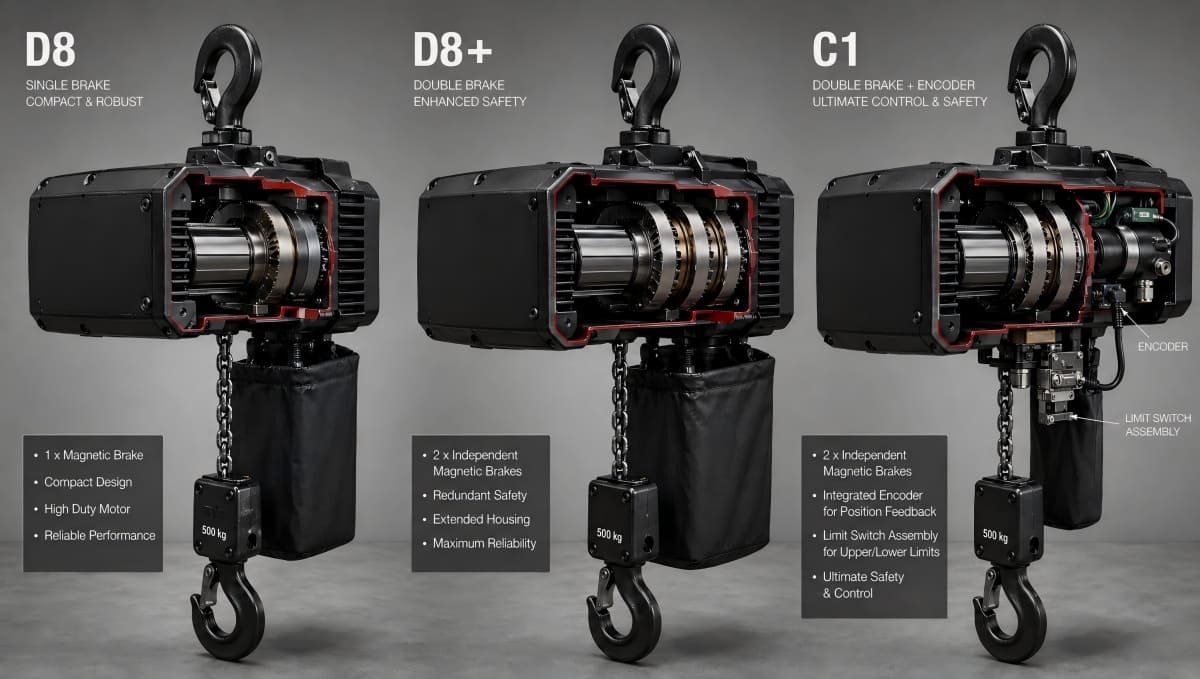
You now have a basic idea, but the details really matter for your projects and your crew's safety. Each standard has specific rules and applications that can impact your budget, setup time, and creative possibilities. Let's dive deeper into each one to see which is the right fit for your needs.
What Exactly Is the D8 Rigging Standard?
Need a basic lifting solution for your stage? A D8 hoist works well, but using it over people introduces serious safety concerns. Here's what you must know before buying.
D8 is the most basic standard for stage hoists.4 It typically has a single brake and is designed for general lifting.5 Crucially, you cannot suspend a load over people with a D8 hoist unless you use a secondary safety device6, like a steel safety cable.
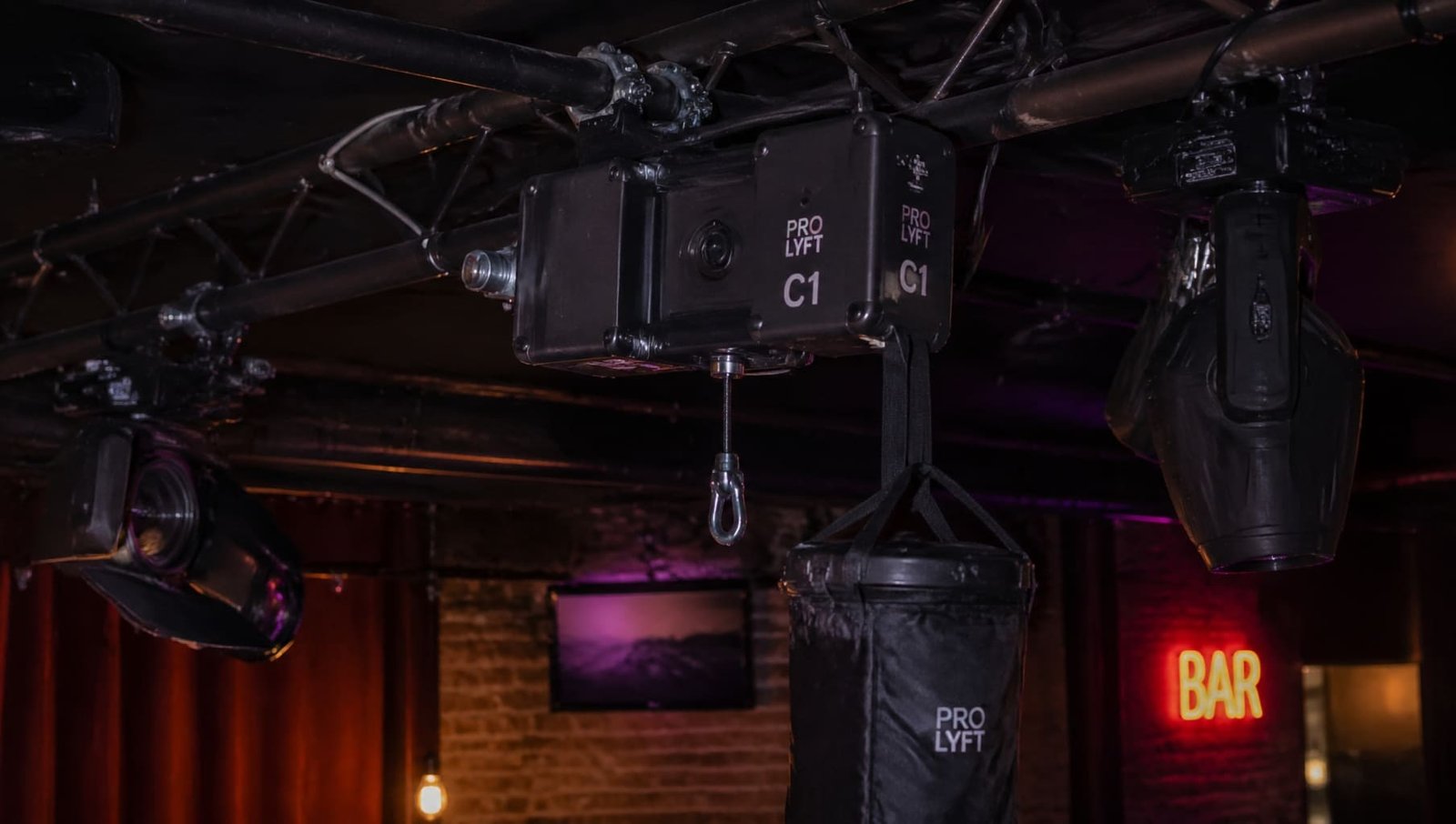
A D8 hoist is the workhorse for many general rigging tasks. Its primary function is to lift loads into position. The most important rule to remember is that because it only has a single brake, it has a potential single point of failure7. This is why regulations are very strict: a D8 hoist cannot hold a load over an area where people are present unless a secondary safety measure is in place. This secondary measure, often a rated steel safety cable or chain, acts as a backup.8 The typical workflow is to lift the truss or equipment, attach the secondary safeties to the structure, and only then allow people to enter the area below.
When is D8 the Right Choice?
This standard is a perfect, cost-effective solution for permanent installations where lighting bars are only moved for maintenance when the building is empty.9 It's also great for pre-rigging an event. You can build your entire lighting or sound truss on the ground, lift it into place with D8 hoists, and then secure it before the doors open.
| Feature | D8 Standard Requirement | Implication for You |
|---|---|---|
| Brakes | Single Brake System | Lower initial cost; requires extra steps for safety. |
| Use Over People | Not Permitted (without secondary safety) | You must add a safety cable for suspended loads. |
| Common Application | Pre-rigging, general lifting | Ideal for setup before an event, not during a show. |
How Does the D8+ Standard Improve on D8?
Worried about the extra work of secondary safeties? D8+ offers a step up in safety, but it still has limitations. Let's see if this upgrade is right for your business.
The D8+ standard improves safety by requiring two independent brakes.10 This allows you to keep a load suspended statically over people without a secondary safety device. However, you are still not allowed to move the load while people are underneath it11.
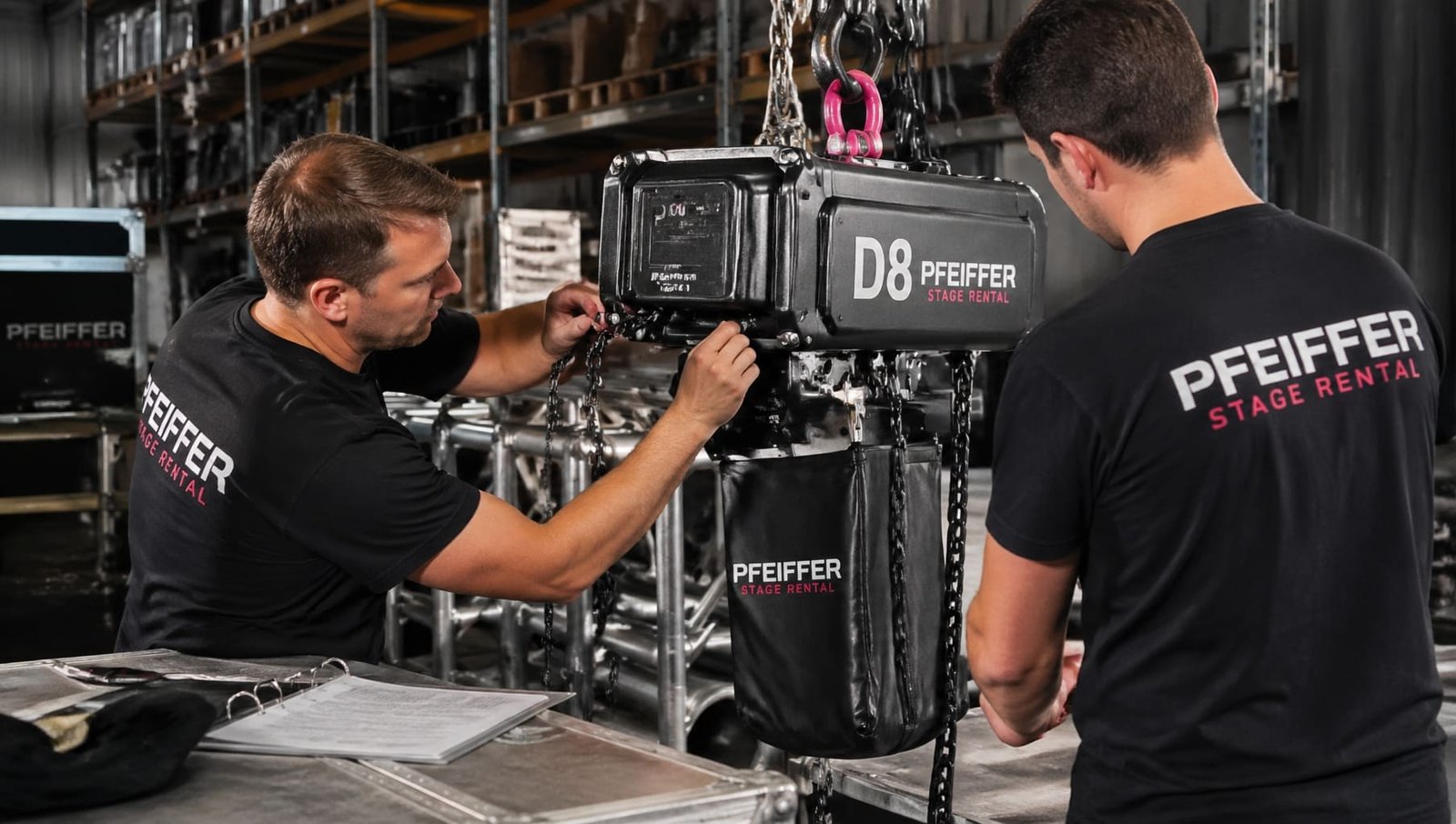
The D8+ standard was created to solve a common industry problem: the time and labor needed to install secondary safeties. The key upgrade is the second, independent brake. This redundancy provides the necessary safety factor to allow a load to be held in a fixed, or "static," position above people. This is a game-changer for efficiency. For a typical concert or trade show, your crew can fly a lighting rig into position and leave it there for the entire event without the extra step of attaching dozens of safety steels.
Is D8+ Enough for Your Show?
For the vast majority of live events, concerts, and exhibitions, D8+ is the ideal standard. It balances safety and efficiency perfectly. Our customers in the event rental business love D8+ hoists because their load-in and load-out times are significantly faster.
Why Is the C1 Standard Considered the Gold Standard?
Need to move scenic elements or lighting above your audience during a show? Standard hoists can't do that safely. The C1 standard is the solution for complex, dynamic productions.
C1 is the highest safety standard, designed for moving loads over people during a performance. It mandates advanced features like double brakes, overload detection, and encoders for precise feedback12.
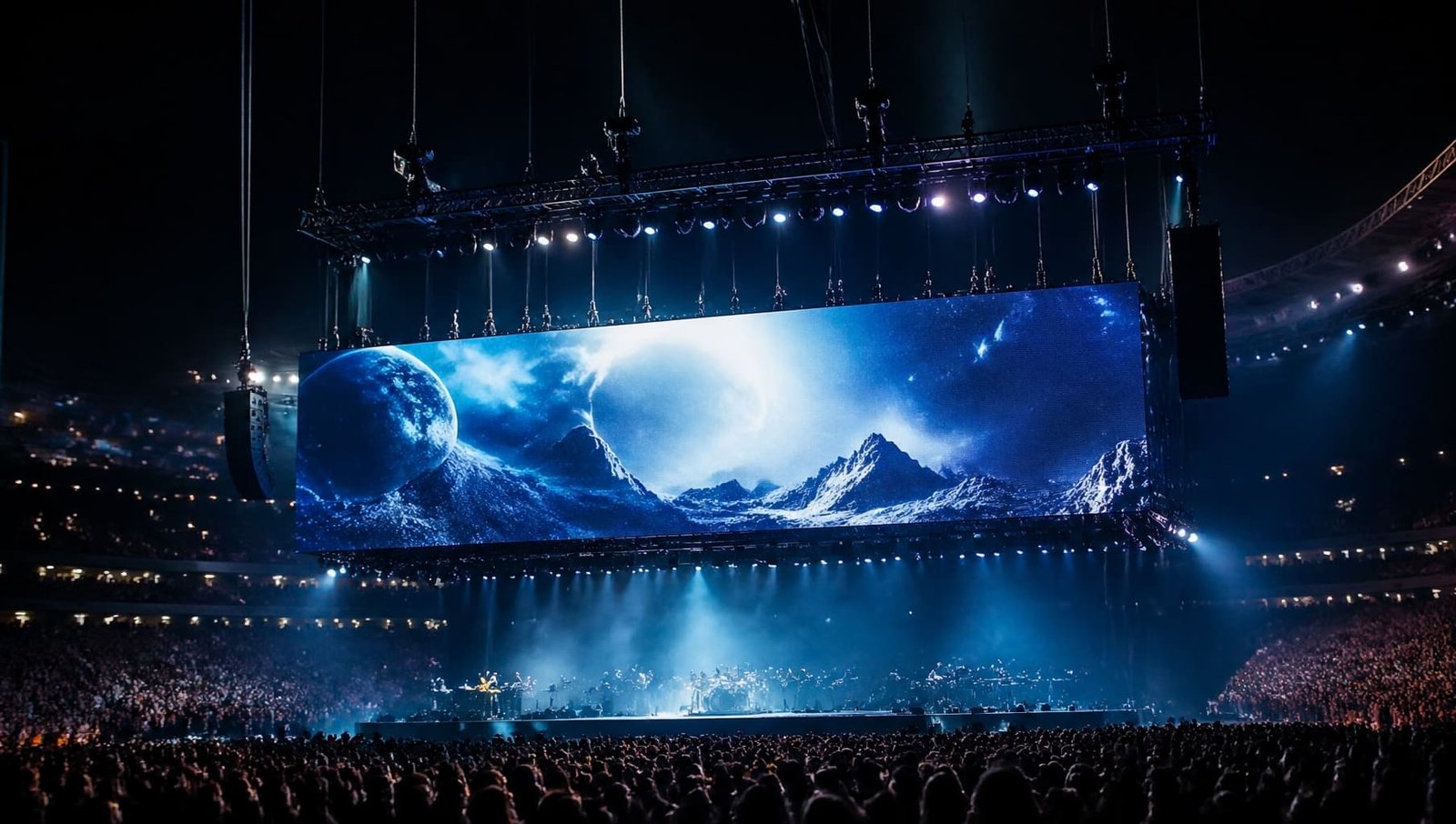
When you want to create truly dynamic visual effects—like moving large video walls or having set pieces appear from the ceiling—you need the C1 standard. This is more than just a hoist; it's a complete safety system. An encoder provides constant, precise feedback on the hoist's position and speed to a central controller, allowing for perfectly synchronized group movements. Overload sensors stop the hoist immediately if it detects a problem, such as a snagged piece of scenery.
The Ultimate in Rigging Safety: C1
We see a growing demand for C1 hoists from large-scale touring productions and modern theaters. While the investment is higher, it is an absolute requirement when there is zero room for error during a live show. It's the technology that makes the magic happen safely.
| Safety Feature | Purpose in a C1 Hoist |
|---|---|
| Double Brakes | Critical redundancy during movement. |
| Limit Switches | Prevents travel beyond designated safe zones. |
| Encoder | Precise positional feedback for automated control. |
| Overload/Underload | Stops the hoist if weight anomalies are detected. |
Conclusion
In summary, D8 is for basic lifting (with secondary safety), D8+ for static holds over people (efficient and safe), and C1 for safe, dynamic movement over audiences. Choose the standard that matches your safety needs and protects your crew.
"D8+ Chain Hoists | Blumano", https://blumano.com/d8-plus-chain-hoist/. German event-rigging guidance distinguishes D8 chain hoists from higher-rated entertainment hoists and states that loads suspended above persons require an independent secondary safety or equivalent protective measure. Evidence role: expert_consensus; source type: institution. Supports: D8 hoists require secondary protection to hold loads over an audience.. Scope note: The support is jurisdictional and standards-based; terminology and legal force may vary outside Germany and the EU. ↩
"Insight from the Experts [Q+A]: Suspending loads with the D8+", https://www.mountainproductions.com/blog/2013/03/12/suspending-loads-with-the-d8/. Entertainment-rigging guidance describes D8+ hoists as enhanced D8 units with redundant braking that may be used to hold stationary loads above persons, provided movement does not occur while persons are underneath. Evidence role: expert_consensus; source type: institution. Supports: D8+ allows static loads over people with its double brake.. Scope note: D8+ is often treated as an industry classification rather than a standalone harmonized international standard, so local acceptance should be verified. ↩
"[PDF] Chain hoists - IGVW", https://www.igvw.org/wp-content/uploads/IGVW_SQP2_web_EN.pdf. DIN 56950-1 and related entertainment-technology guidance classify C1 hoists for controlled movement of loads above persons and specify additional safety functions beyond those used for static suspension. Evidence role: definition; source type: institution. Supports: C1 permits dynamic movement over audiences with advanced safety features.. Scope note: The phrase “highest standard” is a simplified comparative description; the cited standards support the C1 application and requirements rather than a universal ranking across all jurisdictions. ↩
"D8 vs. D8+ vs. C1 Hoists – Understanding Stage Hoist Standards", https://www.glowchaser.com/blog/d8-d8plus-c1-hoist-differences/. Rigging standards and safety guidance commonly describe D8 hoists as general lifting hoists and distinguish them from D8+ and C1 categories that add redundant holding or dynamic-motion safety functions for use above persons. Evidence role: definition; source type: institution. Supports: D8 is the basic/general lifting category compared with D8+ and C1 stage-hoist classifications.. Scope note: “Most basic” is a comparative editorial term; the evidence supports the lower functional category relative to D8+ and C1, not a formal global hierarchy. ↩
"EXE Ace D8 500kg Electric chain hoist", https://www.exetechnology.com/exe-ace/d8-500kg/. D8 chain hoists are generally specified as lifting devices with a single holding brake, whereas use over persons requires additional protection or higher-rated equipment. Evidence role: definition; source type: institution. Supports: A D8 hoist typically has a single brake and is used for general lifting.. Scope note: Individual products can exceed minimum D8-type configurations; the citation would support the typical standard configuration rather than every model sold as D8. ↩
"Insight from the Experts [Q+A]: Suspending loads with the D8+", https://www.mountainproductions.com/blog/2013/03/12/suspending-loads-with-the-d8/. Occupational and event-safety guidance for D8 hoists states that suspended loads above occupied areas must be secured by an independent secondary suspension, such as a rated safety bond, unless a suitable higher-rated system is used. Evidence role: expert_consensus; source type: government. Supports: A D8 hoist cannot be used to suspend loads over people without a secondary safety device.. Scope note: The exact legal requirement depends on national regulations, venue rules, and the adopted standard. ↩
"Single point of failure - Wikipedia", https://en.wikipedia.org/wiki/Single_point_of_failure. Engineering safety literature describes single-point failures as failures of one component that can cause loss of the system’s safety function; a single-brake hoist illustrates this risk unless independent redundancy is added. Evidence role: mechanism; source type: education. Supports: A hoist relying on one brake can create a potential single point of failure.. Scope note: This supports the general safety-engineering rationale; a specific hoist risk assessment would be needed to quantify failure probability for a given model. ↩
"Theatrical Chain | Rigging Warehouse", https://www.riggingwarehouse.com/rw-chain/rw-theatrical-chain.html?srsltid=AfmBOorpjze46hh2DZ0n3bXz4em8Aoy_FckWEJRzook3GvKUwmV4meOJ. Stage-rigging safety references identify rated safety bonds, steel wire ropes, or chains as independent secondary suspensions intended to retain a load if the primary suspension or lifting device fails. Evidence role: mechanism; source type: institution. Supports: Rated steel safety cables or chains function as backup secondary safety devices for suspended stage loads.. Scope note: The citation would support the general role of secondary suspensions; load rating, attachment method, and inspection requirements remain application-specific. ↩
"[PDF] Spacemaster 1 - D8 - 20 Ton DGI Hoist Manual", https://rmhoist.com/sites/default/files/public_files/d8_20_ton_dgi.pdf. Guidance on stage machinery and event rigging permits lower-category lifting equipment for operations performed without persons beneath the load, which provides context for using D8-type hoists in maintenance-only or non-occupied lifting scenarios. Evidence role: general_support; source type: institution. Supports: D8 hoists can be suitable for permanent installations where loads are moved only when people are not underneath.. Scope note: The source would support suitability for unoccupied lifting conditions, not the article’s evaluative words “perfect” or “cost-effective.” ↩
"Breaking Down SQP2:2018 Requirements | Columbus McKinnon", https://www.cmco.com/en-us/resources/blog/breaking-down-sqp22018-requirements/. Industry guidance for D8+ hoists specifies redundant, independently acting brakes as the principal enhancement over D8 equipment for holding suspended loads above persons. Evidence role: definition; source type: institution. Supports: D8+ improves on D8 by requiring two independent brakes.. Scope note: The term D8+ may be implemented through industry guidance or manufacturer conformity statements rather than a single universally adopted international standard. ↩
"Insight from the Experts [Q+A]: Suspending loads with the D8+", https://www.mountainproductions.com/blog/2013/03/12/suspending-loads-with-the-d8/. Rigging guidance differentiates D8+ static suspension from C1 dynamic operation, indicating that D8+ hoists are intended to hold loads above persons but not to move those loads while persons are beneath them. Evidence role: expert_consensus; source type: institution. Supports: D8+ hoists may hold static loads over people but are not intended for movement over people.. Scope note: Local standards or risk assessments may define exceptions or additional control measures, so this should be treated as standards guidance rather than universal statutory language. ↩
"hitachi wj-c1 basic instruction manual detroit hoist program v31", https://www.detroithoist.com/Schematics/Docs/C1%20V31%20Basic%20Instruction%20Manual.pdf?v=12/20/2025%206:22:05%20AM. Standards for entertainment machinery used to move loads above persons describe control and monitoring measures such as load monitoring and position feedback, including encoders, to support safe automated movement. Evidence role: mechanism; source type: institution. Supports: C1 systems use features such as overload detection and encoders to monitor load and position during controlled movement.. Scope note: The exact required sensor architecture can vary by standard edition, risk category, and system design; the citation supports the general C1 safety-function context. ↩
