
What Does a Real Factory Inspection for a Stage Hoist Involve?
Worried your new stage hoists might fail during a critical event? A simple test certificate doesn't guarantee reliability when it matters most. A thorough factory inspection is how you manage this risk.
A proper factory inspection for a stage hoist is a multi-stage risk control process.1 It goes beyond a simple load test to include incoming component checks, detailed assembly verification, and functional testing that simulates real-world stage conditions, ensuring every unit is safe, stable, and reliable.2
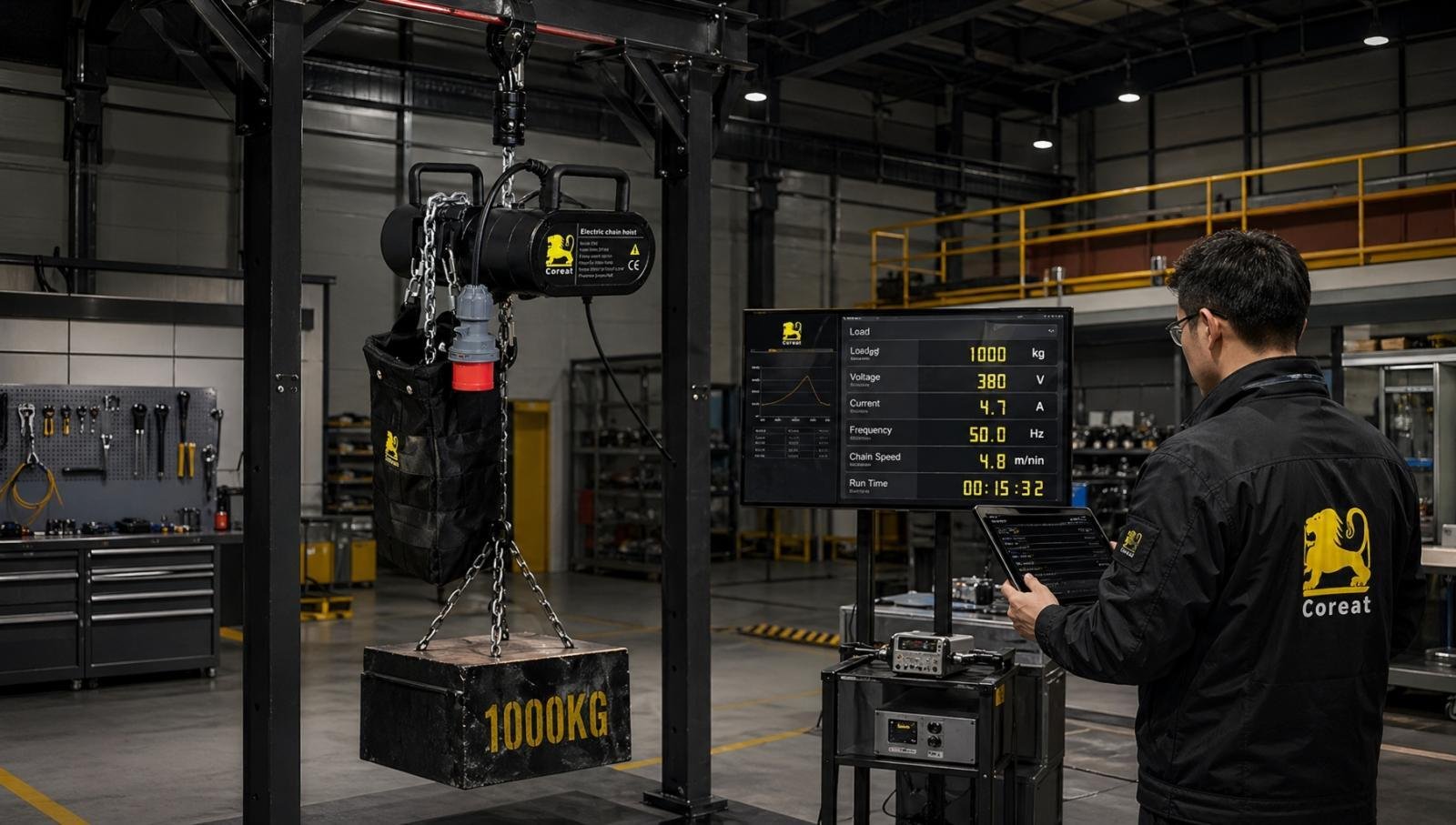
I've seen too many buyers focus only on the final test report. They think if a hoist can lift its rated load, it's good to go. But that's a dangerous oversimplification. The real story of a hoist's quality is written long before that final lift. Let's break down what a truly comprehensive inspection looks like, so you can protect your investment and your reputation.
Why is a factory inspection more than just a load test?
Think a load test video proves a hoist is ready for your stage? That single test misses hidden flaws in components and assembly that can cause failure under real-world stress and use.
A load test only confirms a hoist can lift weight at that moment.3 A full inspection verifies the integrity of every critical part before assembly and ensures the final build is correct. This prevents failures caused by weak materials, poor wiring, or incorrect assembly.
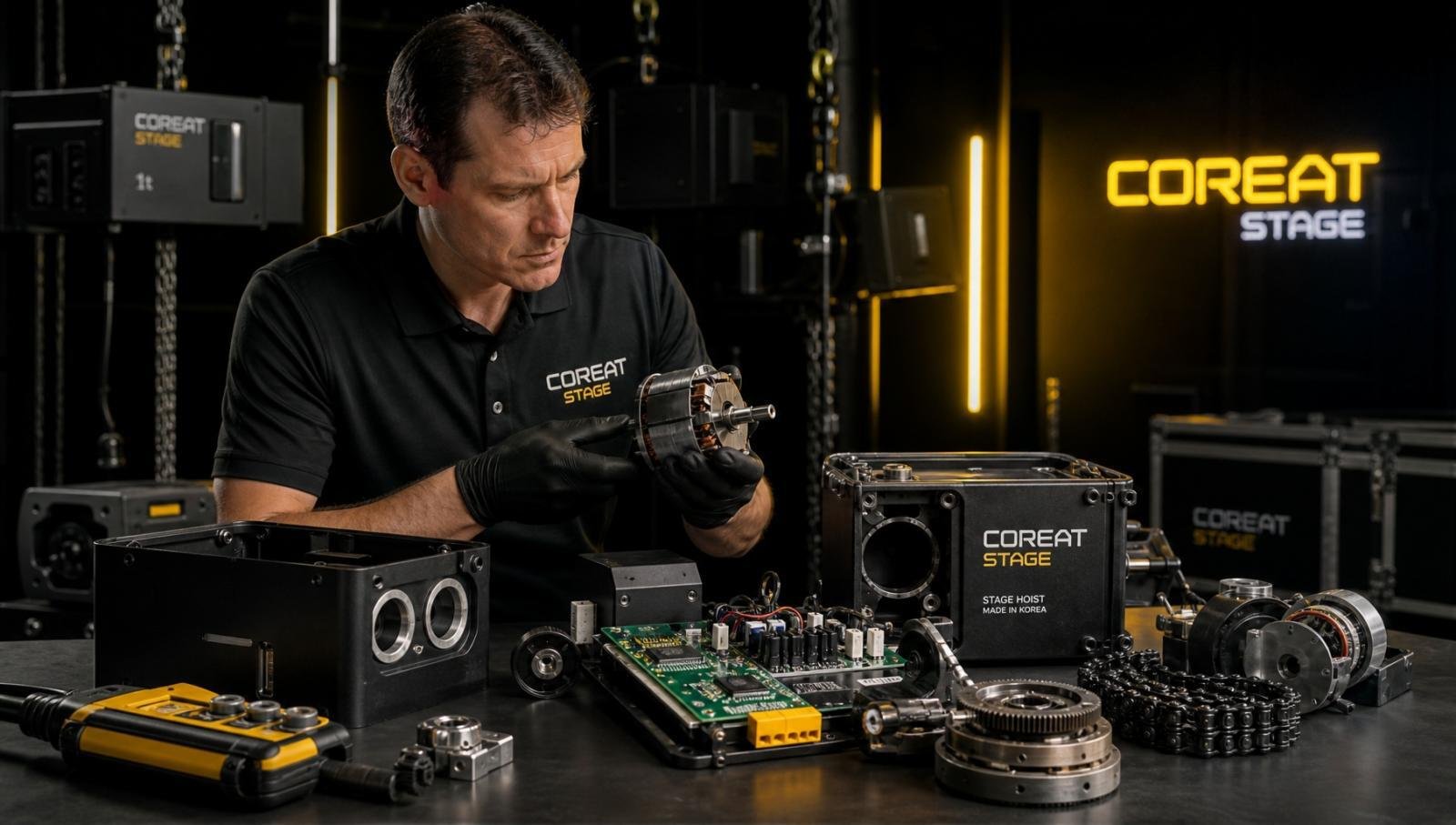
A load test is a result, not a process. It can’t tell you if the motor is wound correctly or if the brake material is up to standard. A hoist could have a weak internal part that passes one test but fails after a dozen uses.4 This is the risk you take when you rely only on a final load test. At our factory, we see inspection as proactive risk management. By checking every component before it even enters the assembly line, we catch potential problems at the source. It’s about building quality in, not just testing for failure at the end. This is the fundamental difference between a product that is simply functional and one that is truly reliable.
Here is a simple breakdown:
| Inspection Method | What It Checks | What It Misses |
|---|---|---|
| Load Test Only | Can it lift the rated load right now? | Component quality, assembly precision, long-term stability |
| Full Inspection Process | Component integrity, correct assembly, performance | Nothing. It is a comprehensive risk-control measure. |
What key components must be checked before assembly?
You assume all internal parts are high-quality, right? But a supplier cutting corners on a single component, like the brake or chain, puts your entire operation and reputation at risk.
Before any hoist is built, we inspect key incoming components. This includes verifying the load chain's material grade, testing the motor's electrical performance, checking the dual-brake system's function, and ensuring the control board's circuitry is flawless. This step eliminates component-level risks.
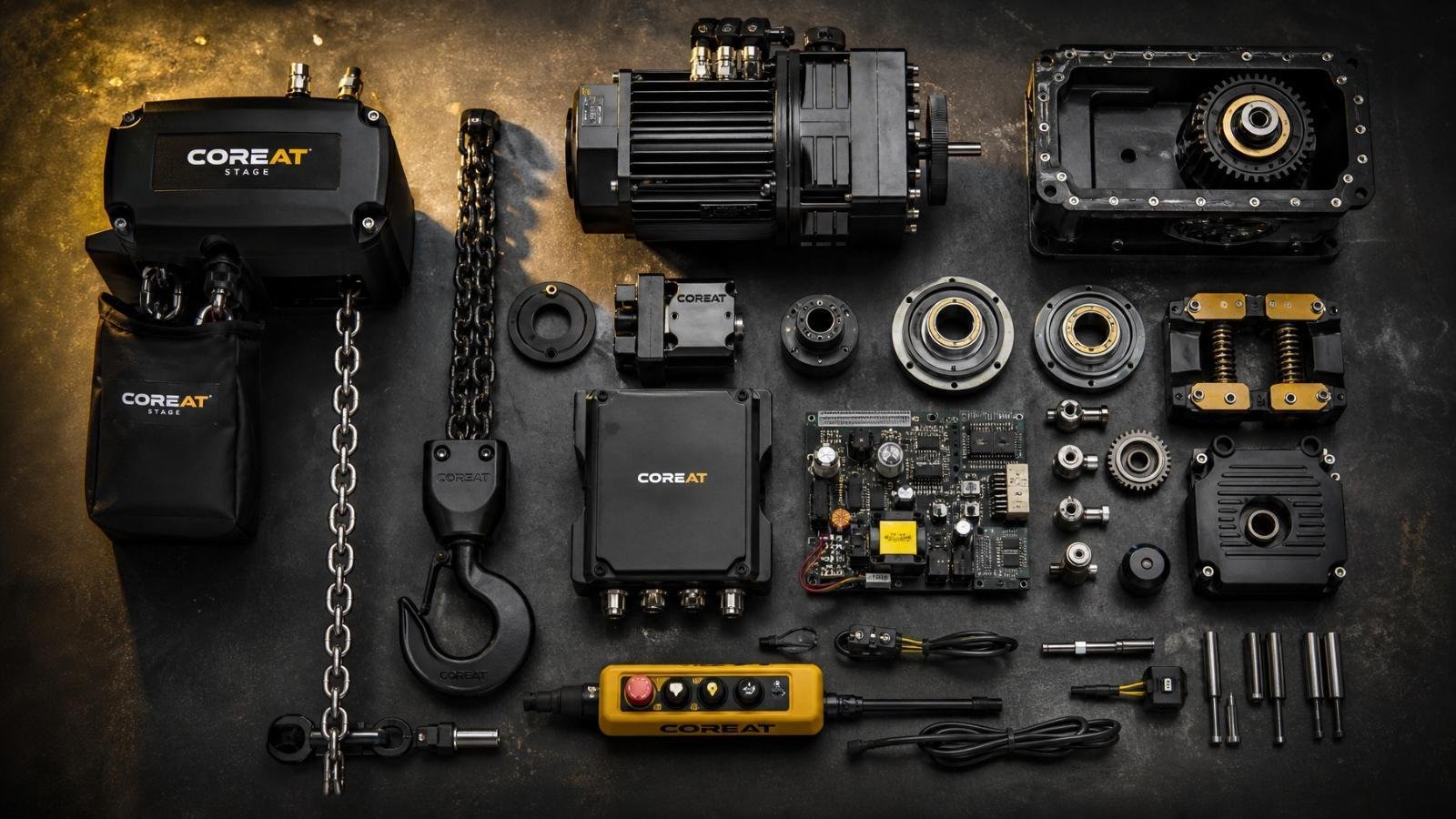
This isn't just a quick visual check. Each component undergoes specific tests to mitigate a specific risk. We don't just trust our suppliers' certificates; we verify them ourselves. For instance:
- Load Chain: We check for material consistency and proper lubrication5. A poorly made chain can cause jamming or wear out prematurely, leading to jerky movements or, worse, failure.
- Motor: We test the motor's insulation and winding.6 A poorly wound motor can overheat during a show, causing a shutdown or permanent damage.
- Dual Brakes: Both brakes are tested independently.7 In entertainment, you need this redundancy. A single point of failure is not an option when people are nearby.8
- Control Board: This is the hoist's brain. We run diagnostics to ensure it responds correctly to every command. A faulty board can lead to erratic behavior or a complete loss of control.
Checking these parts first is non-negotiable. It’s the foundation of a safe and reliable hoist.
How is assembly quality verified in a stage hoist?
Even with perfect parts, a hoist can be a liability. Incorrect assembly can lead to chain jams, loose wiring, or failed limit switches, creating serious safety hazards during a show.
We verify assembly quality through a meticulous checklist. This includes checking fastener torque, ensuring the chain path is clear, confirming limit switches are correctly positioned and functional, and inspecting all internal wiring for secure connections. This ensures the hoist is built exactly as designed.
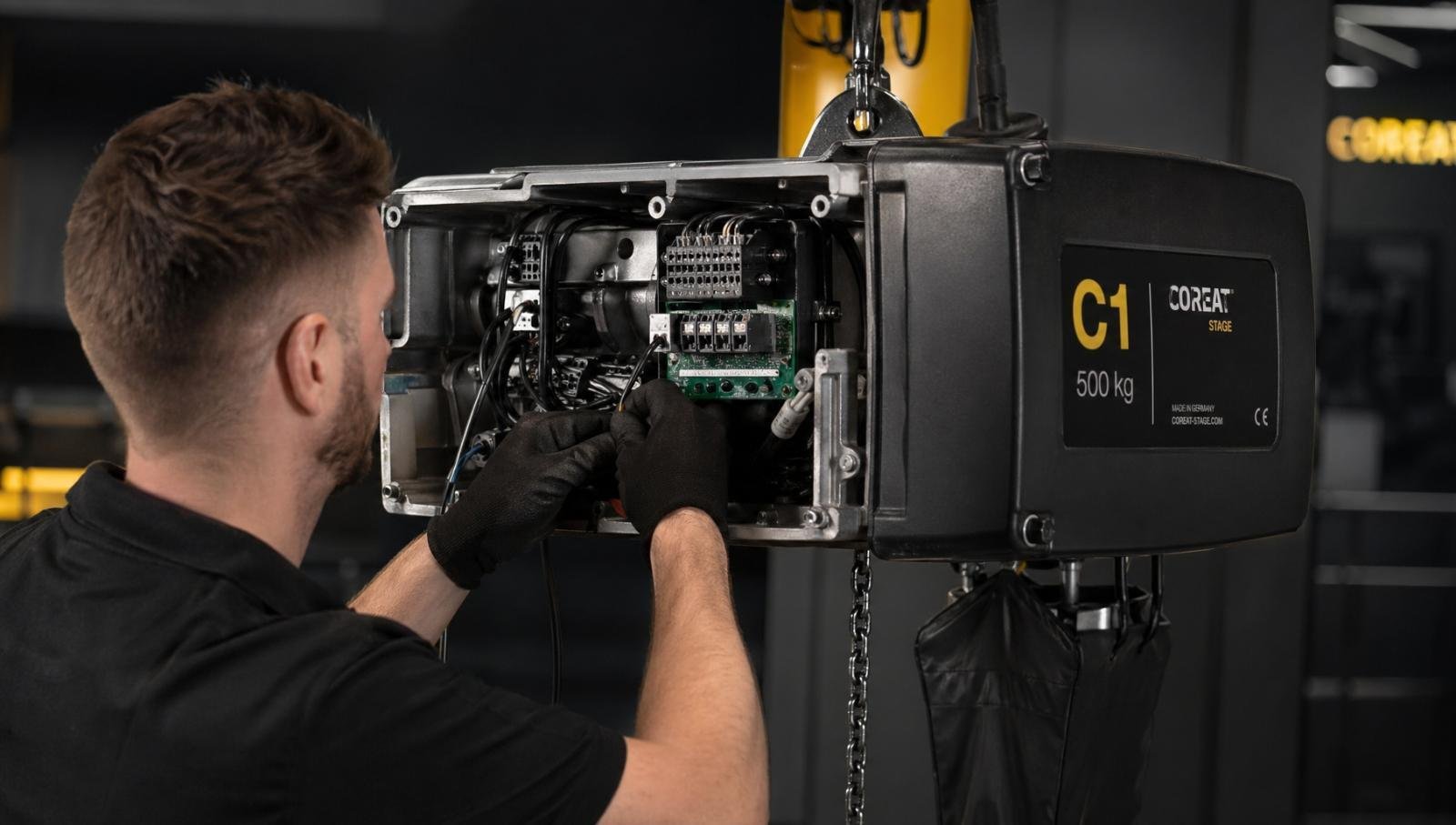
Building a stage hoist is about precision. It's not like assembling furniture. Every step has a purpose tied directly to safety and performance. When we check the assembly, we are looking for things a simple functional test might miss. For example, a wire that is just loosely connected might work during testing but could easily come undone after being transported in a truck. A bolt that isn't torqued correctly could loosen from vibration over time.9 We simulate these real-world conditions in our thinking. Our assembly technicians follow a strict protocol, and a separate quality control team signs off on every single step. This discipline ensures that the 100th hoist we build is just as safe and reliable as the first one.
| Assembly Check Point | Verification Method | Risk If Not Checked |
|---|---|---|
| Fastener Torque | Use a calibrated torque wrench on every bolt. | Parts can loosen from vibration, leading to failure. |
| Chain Path Alignment | Visual and manual check for smoothness. | Premature chain wear, noisy operation, or chain jams. |
| Internal Wiring | Pull test on connectors, check for secure routing. | Intermittent power loss, short circuits, loss of control. |
| Limit Switch Position | Manually trigger switches to test activation. | Hoist can over-lift or over-lower, causing damage.10 |
What makes stage hoist testing different from industrial testing?
Does your supplier test their hoists like they're for a factory, not a theater? Industrial logic focuses on pure lifting capacity, but entertainment rigging demands precision, quietness, and perfect synchronization.
Stage hoist testing focuses on performance criteria unique to entertainment.11 We test for low-noise operation, smooth start/stop functions, precise control response, and braking accuracy. We also simulate multi-hoist system use, as synchronization and group control are critical in our industry.12
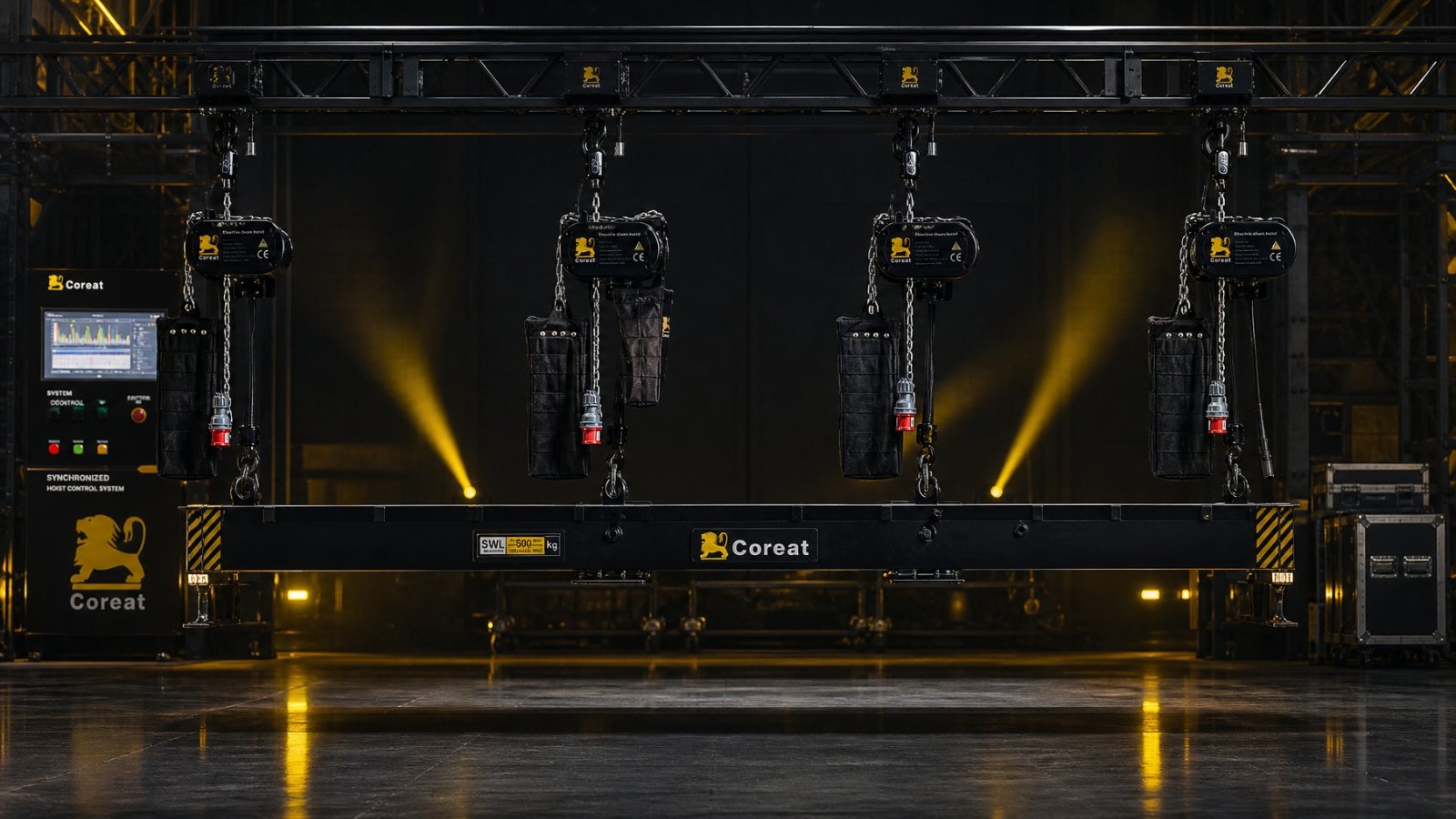
An industrial hoist just needs to lift heavy things. A stage hoist is part of a performance. This changes everything about how it should be tested. A noisy gearbox might be fine in a factory, but it would ruin a quiet scene in a play. A hoist that jerks when it starts or stops can make a moving set piece look unprofessional. That’s why our final testing goes far beyond a simple pass/fail on lifting capacity. We listen for abnormal sounds from the motor and gearbox. We watch how the hoist behaves when paired with a controller, checking for any delay in response. We test the brake to ensure it stops smoothly and precisely, without any drift. And critically, we often test hoists in groups to ensure they can operate together seamlessly. This focus on performance details is what separates a true entertainment hoist from a basic industrial lifter.
| Testing Criteria | Industrial Hoist Focus | Stage Hoist Focus |
|---|---|---|
| Function | Can it lift the rated load? | Does it lift smoothly and quietly? |
| Braking | Does it stop? | Does it stop precisely, without jerking or drifting? |
| Control | Basic up/down functionality. | Precise response, repeatability, and system integration. |
| Noise Level | Not a primary concern. | Must be minimal to avoid disrupting a performance. |
Conclusion
In short, a comprehensive factory inspection is your best insurance against failure. It reduces risk, ensures reliability, and proves a supplier is committed to your safety and your show's success.
"1926.554 - Overhead hoists. | Occupational Safety and Health ...", http://www.osha.gov/laws-regs/regulations/standardnumber/1926/1926.554. Hoist safety standards such as ASME B30.16 and entertainment-rigging guidance distinguish inspection, testing, maintenance, and operational checks, supporting the view that factory inspection is a staged risk-control process rather than a single event; this is contextual support and does not verify any specific factory procedure. Evidence role: expert_consensus; source type: institution. Supports: Hoist safety standards and guidance treat inspection as a structured process involving multiple checks of hoist condition, function, and safety-critical parts.. Scope note: Contextual support for the inspection approach, not direct evidence about the author's factory. ↩
"Incoming Inspection: Do we have to inspect everything? - ISO 9001", https://the9000store.com/iso-9001-2015-requirements/iso-9001-2015-operational-requirements/incoming-inspection/. Quality-management standards such as ISO 9001 require control of externally provided components and production verification, while hoist standards require inspection and functional checks of safety-critical parts; together these sources support multi-stage inspection, although they do not prove that such testing alone guarantees reliability. Evidence role: general_support; source type: institution. Supports: Quality-management and hoist-safety standards support the use of incoming verification, production controls, and functional inspection for safety-critical equipment.. Scope note: Supports the inspection structure generally; does not substantiate the absolute assurance that every unit will be safe and reliable. ↩
"1910.179 - Overhead and gantry cranes. - OSHA", http://www.osha.gov/laws-regs/regulations/standardnumber/1910/1910.179. Hoist inspection standards treat load testing as one element of evaluating lifting equipment and separately require inspection of items such as hooks, chain, brakes, and controls, indicating that a successful load lift is not a complete assessment of hoist condition. Evidence role: definition; source type: institution. Supports: A load or proof test is a test of current lifting performance and is separate from broader inspection of hoist components and condition.. ↩
"Fatigue (material) - Wikipedia", https://en.wikipedia.org/wiki/Fatigue_(material). Materials-engineering literature on fatigue failure shows that cracks or weak points may remain below critical size during an initial proof load and propagate under repeated cycles, supporting the possibility that a hoist component can pass one test but fail later. Evidence role: mechanism; source type: paper. Supports: Fatigue and latent defects can allow a mechanical component to survive an initial proof load yet fail after repeated cyclic loading.. Scope note: General fatigue mechanism; not specific to the particular hoist model described. ↩
"ASME B30.16-2022", https://dl.gasplus.ir/standard-ha/Standard-ASME/ASME%20B30.16-2022.pdf. Hoist maintenance guidance and standards identify load-chain condition and lubrication as inspection items, supporting the claim that lubrication is relevant to wear control and reliable chain movement. Evidence role: mechanism; source type: institution. Supports: Load-chain lubrication is a recognized maintenance and inspection concern because it affects wear, movement, and service life.. ↩
"[PDF] IEEE Standard Test Code for Resistance Measurement", https://engineering.purdue.edu/~dionysis/EE452/Lab12/IEEEstd_118.pdf. Electrical-maintenance standards and motor-testing guidance describe insulation-resistance and winding tests as methods for assessing motor condition and detecting faults that may cause overheating or failure. Evidence role: mechanism; source type: institution. Supports: Motor insulation and winding tests are standard methods for detecting electrical deterioration or defects that can lead to failure.. ↩
"[PDF] ANSI E1.6-1 - ESTA Technical Standards Program", https://tsp.esta.org/tsp/documents/docs/ANSI%20E1.6-1%20-%202019.pdf. Entertainment-machinery and powered-hoist standards treat braking systems as safety-critical functions and require verification of their operation, supporting independent testing of redundant brakes where a dual-brake design is used. Evidence role: expert_consensus; source type: institution. Supports: Entertainment machinery and powered-hoist standards address braking systems and the need to verify safety functions, including redundant braking where required.. Scope note: Applies when the hoist is designed with redundant brakes or used in applications where such redundancy is required. ↩
"1926.1425 - Keeping clear of the load. | Occupational Safety ... - OSHA", http://www.osha.gov/laws-regs/regulations/standardnumber/1926/1926.1425. Occupational-safety guidance on suspended loads warns against exposing people to loads that could fall and requires controls to prevent hazardous failures, supporting the concern that hoists used near people should not depend on a single unprotected failure point. Evidence role: expert_consensus; source type: government. Supports: Safety authorities restrict exposure of people to suspended loads and emphasize controls that prevent load-drop hazards.. Scope note: Supports the safety principle broadly; specific redundancy requirements vary by jurisdiction, standard, and application. ↩
"Preload Loss in a Spacecraft Fastener via Vibration-Induced ...", https://ntrs.nasa.gov/citations/20180002978. Mechanical-engineering studies of bolted-joint self-loosening, including transverse-vibration testing, show that vibration can reduce clamping force and loosen fasteners, supporting the need for correct torque verification. Evidence role: mechanism; source type: paper. Supports: Vibration can reduce preload and cause self-loosening in bolted joints, especially when initial tightening or locking measures are inadequate.. ↩
"1910.179 - Overhead and gantry cranes. - OSHA", http://www.osha.gov/laws-regs/regulations/standardnumber/1910/1910.179. Hoist standards and inspection guidance describe upper and lower limit devices as protective controls against overtravel, supporting the claim that incorrect limit-switch positioning can permit damaging over-lift or over-lower conditions. Evidence role: mechanism; source type: institution. Supports: Hoist limit devices are intended to prevent overtravel at the upper or lower ends of movement, reducing the risk of equipment damage or unsafe conditions.. ↩
"[PDF] ANSI E1.6-1 - ESTA Technical Standards Program", https://tsp.esta.org/tsp/documents/docs/ANSI%20E1.6-1%20-%202019.pdf. Entertainment-technology standards for powered hoists and stage machinery address requirements specific to performance environments, supporting the claim that stage-hoist testing should consider more than rated lifting capacity. Evidence role: expert_consensus; source type: institution. Supports: Entertainment-hoist and stage-machinery standards address application-specific requirements for controlled movement, safety functions, and use in performance environments.. Scope note: Contextual support; the exact tests required depend on the applicable standard, hoist type, and production use. ↩
"[PDF] ANSI E1.6-1 - ESTA Technical Standards Program", https://tsp.esta.org/tsp/documents/docs/ANSI%20E1.6-1%20-%202019.pdf. Stage-machinery and entertainment-hoist standards discuss coordinated or group control of multiple lifting devices, supporting the importance of synchronization when several hoists move a common or visually coordinated load. Evidence role: mechanism; source type: institution. Supports: Stage machinery and entertainment-hoist guidance discusses coordinated control of multiple lifting devices to manage shared loads and controlled movement.. Scope note: Supports the importance of synchronization generally; it does not show that every stage-hoist application requires group control. ↩